
↑ Parent Menu⌂ Main Menu
← Chapter 3.8 Risk Ratings and Ground Hazard Risk Assessment
GHRM
Railway Ground Hazard Risk Management · 3.0 · Risk Management
Sections · open a dropdown to go to a section or subsection

3.8.45 Case Studies

Rating ground hazard risk now, and how much each solution will reduce it: triggering mechanisms, current risk, and risk reduction ratings.
Author: Daniel P. Colwell
3.8.45 Case Studies

Field case studies by Burt G. Look, from Earthworks: Theory to Practice – Design and Construction (CRC Press/Balkema, 2023), chosen for this chapter’s topics. Each is summarized from the book with its key figures and a closing note on railroad application added by the authors of this manual. Credit for the case material belongs to Look; see item S4 under Supplemental References.

Case Study 4.18.1 — Slope failures whose consequences left the site
Case study · Look (2023) §3.8

Related section: 3.8.3 Embankment and Slope Failure Mechanisms

Look uses three historical failures to show that a slope’s safety obligations extend beyond the construction boundary:

  • Aberfan, South Wales (1966). Colliery spoil tips had been built over highly porous sandstone containing numerous springs. After heavy rain, water built up in the tip and it failed as a slurry flow that travelled about 1,430 ft downhill, killing 144 people, 116 of them schoolchildren.
  • Samarco tailings dam, Brazil (2015). The collapse flooded downstream villages, killed 19 people and carried pollutants more than a hundred miles down watercourses. Look notes an upward trend in deaths from tailings-dam failures.
  • Po Shan Road, Hong Kong (1972). After about 27.6 in of rain in three days, a landslip on a developed hillside with cuttings killed 67 people. It led to the formation of the Geotechnical Control Office in 1977 (now the Geotechnical Engineering Office).

Most slope instability is smaller and stays on site, costing time and money; but a single 12 in boulder from a cutting can reach a traffic lane or a house 164 ft away.

For railroad work: a track at the toe of mine spoil, a tailings embankment or a steep developed hillside is exposed to a failure that starts on someone else’s property. Section 3.8.3’s flow-slide mechanisms apply, and these sources belong on the hazard inventory even when they are outside the right-of-way.
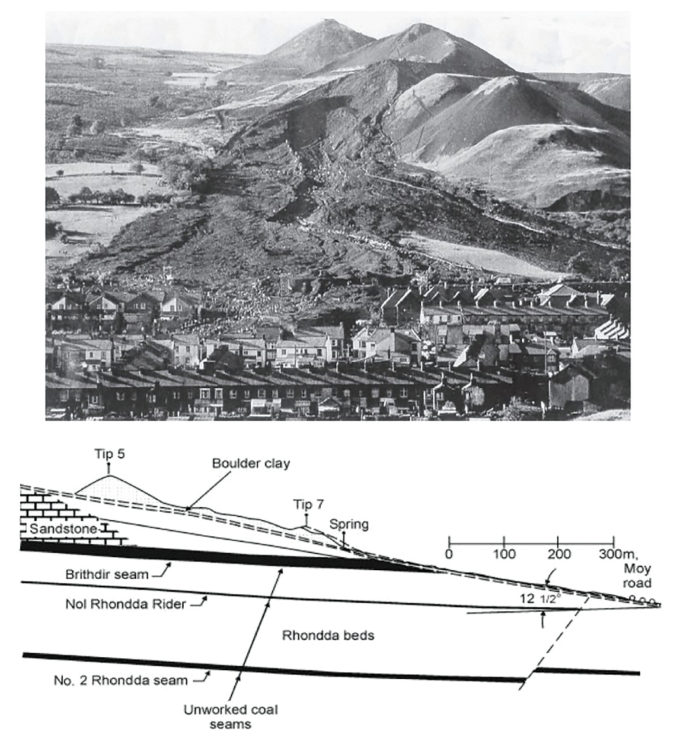
Aberfan, 1966: flow of uncontrolled colliery spoil over porous sandstone with springs (after Bromhead 1992).
Figure 4-LK1. Aberfan, 1966: flow of uncontrolled colliery spoil over porous sandstone with springs (after Bromhead 1992). Source: Look (2023), Figure 3.8-42, p. 91.

Source: Look, B. G. (2023). Earthworks: Theory to Practice – Design and Construction. CRC Press/Balkema. Case study §3.8, pp. 92. Summarized and paraphrased; figures reproduced for internal reference. Full reference under Supplemental References.

← Previous · 3.0 Risk Management Chapter 3.7 — Cost Estimates
Next · 3.0 Risk Management → Chapter 3.9 — Geotechnical Investigation Planning and Scope