
Geotechnical engineering libraryContact
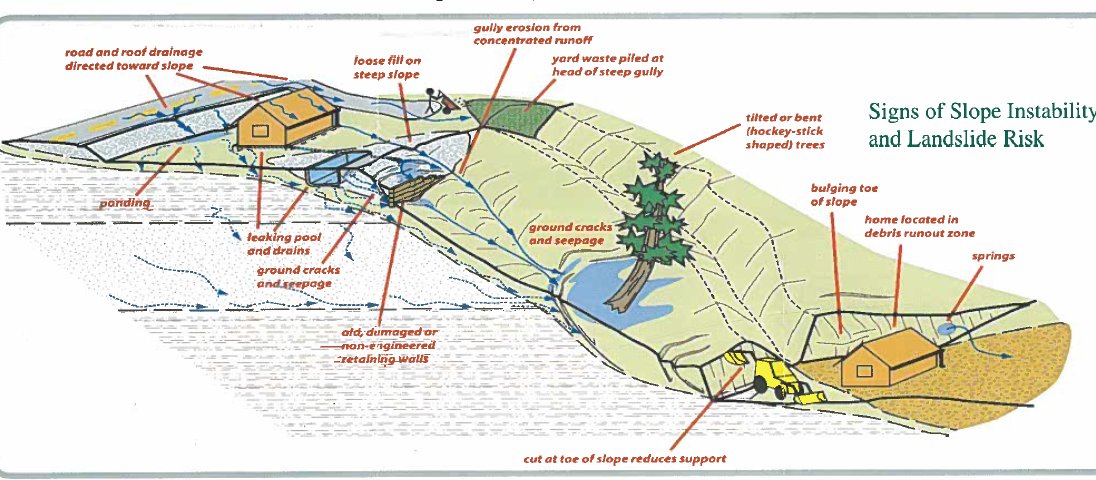
Most failures are set off by water. Load and human activity come next.
| Trigger | How It Acts | Mechanisms Most Affected |
|---|---|---|
| Intense short-duration rainfall | Surface runoff, erosion, rapid rise of perched water | Debris flow, shallow slides, washout, scour |
| Prolonged rainfall and antecedent moisture | Raises groundwater and pore pressure over days to weeks | Deep-seated slides, subgrade softening, pumping |
| Snowmelt and rain-on-snow | Large water input on saturated or frozen ground | Slides, washouts, thaw weakening |
| Freeze-thaw cycles | Ice wedging in rock; ice lens growth and melt in soil | Rockfall, frost heave, spring pumping |
| Flood and high water | Scour, overtopping, saturation of embankments | Scour, washout, piping |
| Rapid drawdown | Loss of external water support on a saturated slope | Slides of river-bank embankments |
| Blocked drainage | Ponding against embankments; water forced through fill | Piping, slides, subgrade softening |
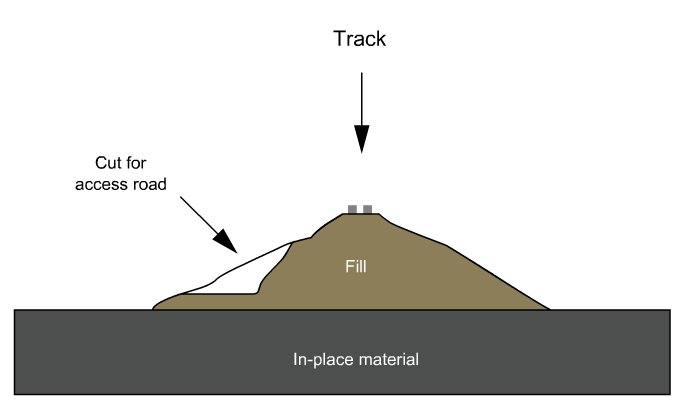
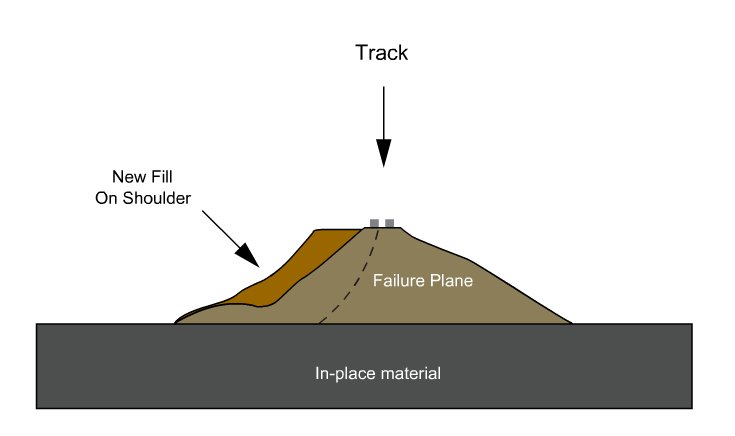
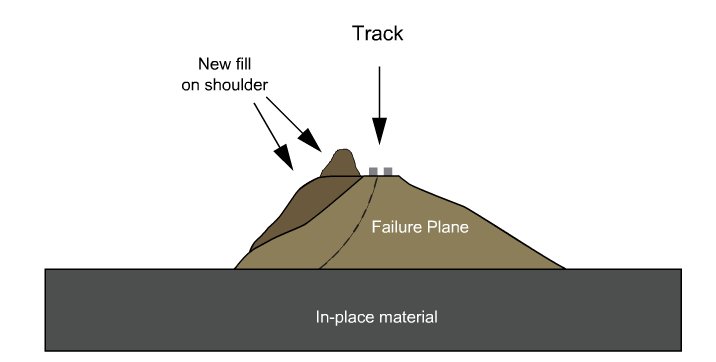
| Increased load | Heavier axle loads, higher tonnage or speed, new track, stockpiles near crest | Progressive shear, cumulative deformation, slides |
| Construction and maintenance | Toe excavation, ditch cleaning that undercuts slopes, undercutting, vegetation removal, grade raises | Slides, erosion, settlement |
| Earthquake | Cyclic loading and inertial forces | Liquefaction, lateral spread, slides, rockfall |
| Wildfire | Loss of vegetation and water-repellent soils increase runoff for several seasons | Debris flow, erosion |
| Beaver activity | Impounds water against fills; dams fail in storms | Washout, piping |
| Utility leaks and mining | Localized water or loss of support | Sinkholes, collapse, settlement |
Climate trends matter for risk evaluation. Where records show more frequent intense rainfall, return-period assumptions behind existing drainage and past stability evaluations may no longer hold. Note this in the risk evaluation (Chapter 1.1, Section 1.1.7) rather than assuming past performance will continue.
A trigger is an external stimulus that causes a near-immediate landslide or washout by raising stress, reducing strength or removing soil: intense or persistent rain, floods, high stream flow, rapid snowmelt, earthquakes, elevated seepage, water-level change, freeze–thaw and rapid drawdown. Weather is the most common trigger, and antecedent wetness matters as much as the storm. Underlying causes are geological (weak, sensitive, weathered or jointed materials, adverse bedding, permeability contrasts), morphological (toe erosion, piping, crest loading, vegetation loss, thaw) and human (toe excavation, crest loading, reservoir drawdown, deforestation, irrigation, vibration, leaking utilities).
Water weakens slopes in five ways: it adds weight in the voids, is absorbed by clay minerals with loss of strength, dissolves cement between grains, erodes loose material, and becomes trapped under pressure. A failure surface balances driving and resisting mass, and four actions tip it the wrong way: steepening the slope, removing support at the toe, adding mass high on the slope, and allowing bad drainage to continue.
After Geotechnology for Railroaders Program, Module 5, Module 6.4; Module 5 §10, §14; Module 6.4 §07. Full reference under Supplemental References.