
↑ Parent Menu⌂ Main Menu
← Chapter 5.2 Laboratory Testing Program
GHRM
Railway Ground Hazard Risk Management · 5.0 · Testing
Sections · click a car to open it

5.2.4 Sample Handling and Chain of Custody

Laboratory testing is the scientific foundation of every geotechnical design.
Authors: Daniel P. Colwell and Mario Ruel
5.2.4 Sample Handling and Chain of Custody
5.2.4.1 Shelby Tube Handling

Shelby tubes (ASTM D1587, withdrawn 2024 thin-wall samples) must be:
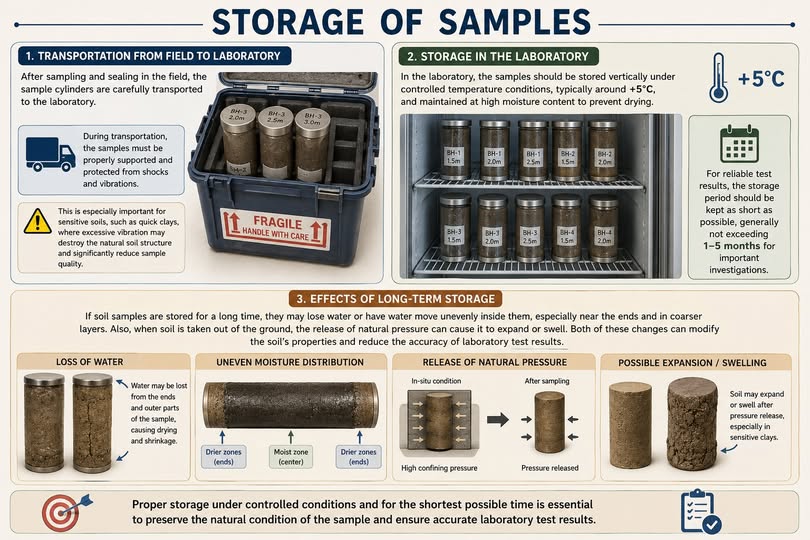
Storage of Samples
Storage of Samples
  • Sealed at both ends with wax within 2 hours of extraction
  • Stored vertically (upright) in a padded core box or individual foam holders
  • Transported at ambient temperature; never frozen (unless specifically permitted for permafrost)
  • Extruded at laboratory in a horizontal extruder within 30 days of collection
  • Never impact-loaded, dropped, or inverted during transport

Sample Quality Designation (Lunne et al. 1997, for OCR 1–2) — also referenced in Chapter 4.1:

Δe/e₀Quality
< 0.04Very good to excellent
0.04–0.07Good to fair
0.07–0.14Poor
> 0.14Very poor

Report SQD for all consolidation and triaxial test specimens. Note samples with SQD = Poor or Very Poor in the report, with a caveat on the reliability of the strength and compressibility parameters derived from them.

5.2.4.2 Chain of Custody

A chain of custody (COC) form must accompany every sample shipment from field to laboratory. Required fields:

  • Project name and number; client railroad
  • Boring ID, sample ID, sample type, and depth interval
  • Date and time of collection; collector's name
  • Date and time of departure from field; shipper's name
  • Date and time of receipt at laboratory; receiver's name and signature
  • Condition of samples at receipt (sealed, intact, disturbed)
  • Tests assigned (referenced to lab test request form)
  • Custody transfer: any intermediate handler must sign and date

Owner railroads may require COC forms to be scanned and submitted with the laboratory report as a QC attachment.

← Previous · 5.0 Testing Chapter 5.1 — In Situ Testing
Next · 5.0 Testing → Chapter 5.3 — Construction Monitoring and Field Testing