
Geotechnical engineering libraryContact
Field case studies by Burt G. Look, from Earthworks: Theory to Practice – Design and Construction (CRC Press/Balkema, 2023), chosen for this chapter’s topics. Each is summarized from the book with its key figures and a closing note on railroad application added by the authors of this manual. Credit for the case material belongs to Look; see item S12 under Supplemental References.
Related section: 5.3.2 Compaction Testing
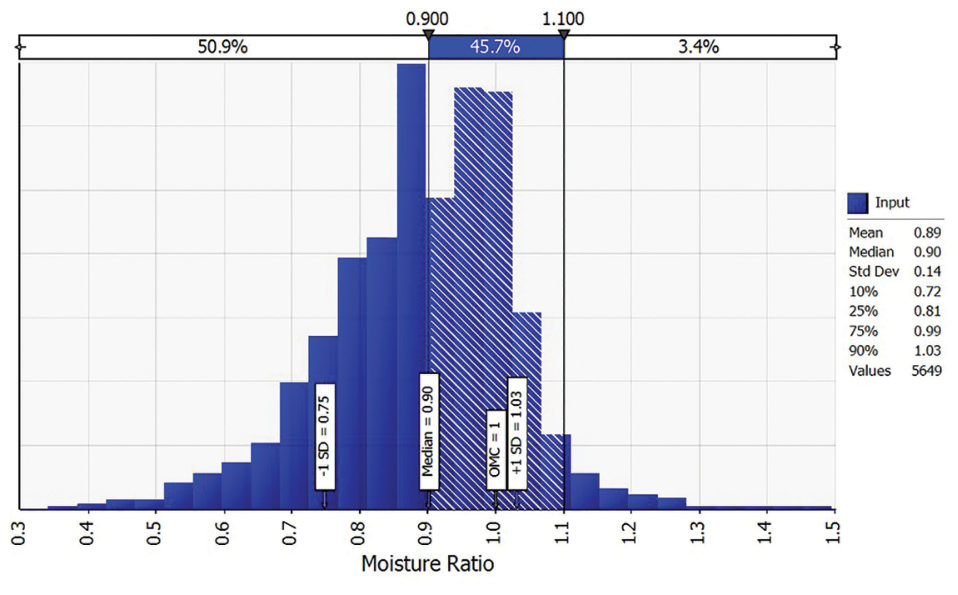
Look examined 5,649 compaction results, mainly low- to medium-plasticity material, all meeting a 95% density ratio target. Placement moisture was mostly dry of optimum:
The median was 90% of OMC, with a ±1 standard deviation range of 75%–103%. Heavy equipment has its own “optimum” dry of laboratory OMC because it delivers so much energy. For 279 tests on high-quality base material (CBR 45), the median density was 103% of MDD at a median moisture of only 63% of OMC.
Laboratory OMC is not a requirement for reaching density in the field. It ignores both the equipment used and the moisture the material will reach in service.
For railroad work: on embankment and subgrade work, a density pass with heavy rollers dry of OMC is common. Where the fill is a plastic clay that will wet up afterwards, see the expansive-clay case in Chapter 2.1.
Source: Look, B. G. (2023). Earthworks: Theory to Practice – Design and Construction. CRC Press/Balkema. Case study §7.8, pp. 228–230. Summarized and paraphrased; figures reproduced for internal reference. Full reference under Supplemental References.
Related section: 5.3.4 Pile Installation Monitoring
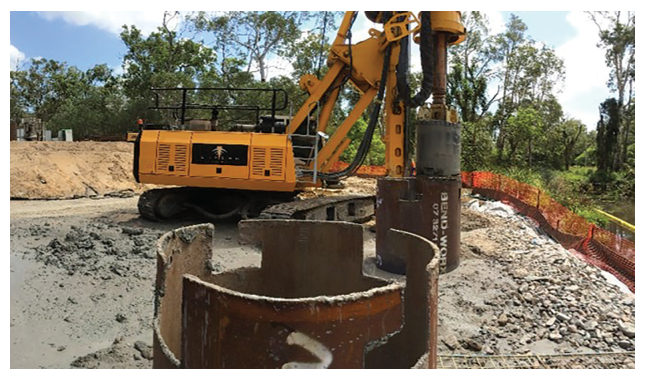
A temporary liner was socketed to the top of rock for a bored pile. While soil was being extracted from inside the liner, a sinkhole opened next to it: bedrock dipped at depth, the liner was embedded unevenly, and material caved in under the edge. The piling rig and the site supervisor were right beside the liner. The operator reversed the rig and the supervisor stepped away in under a minute, and nobody was hurt.
The platform itself was correctly designed; no working platform can bridge a void of this kind. Look draws three points from it: rig operators must be ready to act without notice, so phones should be restricted in critical areas; old trenches and services should be marked and avoided; and instrumentation (survey, inclinometers, extensometers, settlement gauges, piezometers, earth pressure cells) gives early warning, and should be mandatory where the factor of safety is 1.2 or less. Offset distances of about 6.6 ft, or three times the track width of tracked plant, should be kept from any sloping edge.
For railroad work: bridge piling next to live track adds train surcharge and vibration to the same mechanism. Casing embedment on sloping rock should be confirmed, and the exclusion zone around an open casing should be part of the track-protection briefing.
Source: Look, B. G. (2023). Earthworks: Theory to Practice – Design and Construction. CRC Press/Balkema. Case study §3.6, pp. 88–90. Summarized and paraphrased; figures reproduced for internal reference. Full reference under Supplemental References.