
Geotechnical engineering libraryContact
The geotechnical inspector is responsible for a daily field report for each day of active monitoring. Minimum content:
Owner railroads commonly require daily field reports to be submitted electronically (PDF) within 24 hours, through their project portal or by email with a set naming convention.
| Test No. | Date | Station | Lift No. | Depth (in.) | γ_d,field (pcf) | MC (%) | γ_d,max (pcf) | RC (%) | Min. RC (%) | Pass/Fail |
|---|---|---|---|---|---|---|---|---|---|---|
| 001 | 06/01/26 | 240+50 | 3 | 6 | 121.4 | 10.2 | 127.0 | 95.6 | 95.0 | Pass |
| 002 | 06/01/26 | 241+00 | 3 | 6 | 118.7 | 12.5 | 127.0 | 93.5 | 95.0 | Fail |
| 003 | 06/01/26 | 241+00 | 3 | 6 | 122.1 | 10.8 | 127.0 | 96.1 | 95.0 | Pass (retest) |
A pile driving log must be completed for every driven pile:
Have the final pile driving log signed by both the geotechnical inspector and the railroad construction inspector.
During execution, the course compares progress to plan with three tools: quality reviews, Gantt schedule performance charts and cost performance charts. Its cost chart plots cumulative planned value (PV) against cumulative actual cost (AC) by week. In the example, planned value reaches $44,000 by week 5 against an actual cost of $66,000, so spending is 50% above plan and the gap has widened every week.
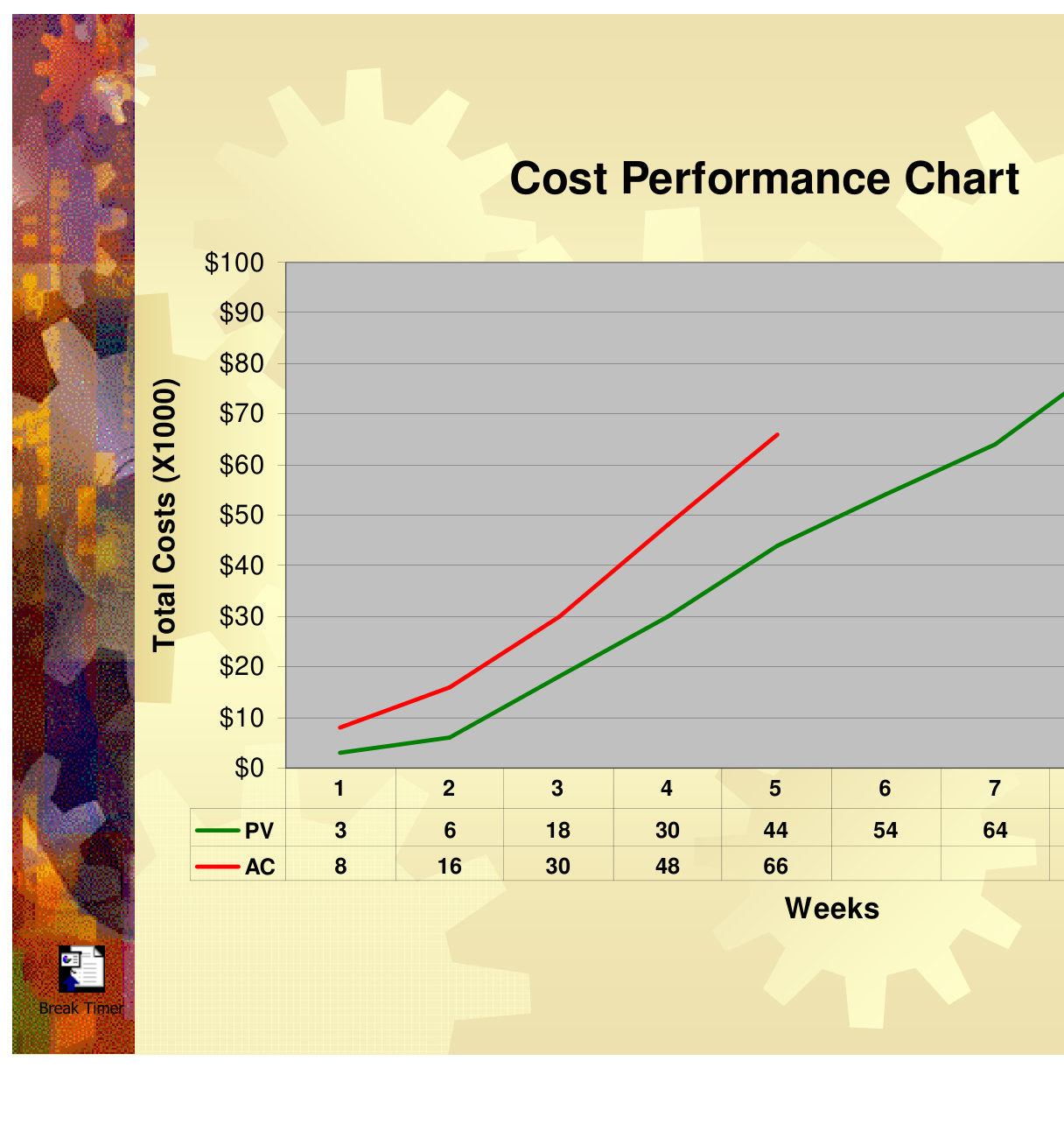
Table 15-PM1. Cumulative planned value and actual cost, $1,000 (after Skill Right 2013, Cost Performance Chart)
| Week | 1 | 2 | 3 | 4 | 5 |
|---|---|---|---|---|---|
| PV | 3 | 6 | 18 | 30 | 44 |
| AC | 8 | 16 | 30 | 48 | 66 |
For change, the course separates customer-requested changes (usually the largest source) from internal requests, regulation and team-generated changes. Its procedure is: hold a team meeting, explain the change, get feedback, identify alternatives, prepare a decision matrix, select a recommendation, present it to management or the customer, and implement the approved course.
For railroad work: a PV-versus-AC chart cannot by itself tell overspending apart from work being done ahead of schedule. Add the budgeted value of the work actually performed, measured in physical units: inspector shifts actually needed, density tests, piles observed, monitoring rounds and reports issued. Construction-phase geotechnical budgets on railroad projects are often consumed by standby and repeat mobilizations when track windows are cancelled or the contractor’s sequence changes. Log those days as a separate cost line from the first occurrence. Then, when the change procedure is invoked, the decision matrix compares real alternatives:
Report cost status with the same frequency and in the same document as the QA/QC test summaries, so the railroad sees quality, schedule and cost together.
Source: Skill Right (2013). Project Management Tools and Techniques: An Introductory Course in Project Management Foundations [training slides sponsored by Texas Instruments, Inc.; minor modifications by N. Santiago, Spring 2013 version], slides 81–83, 86–87. Summarized and paraphrased; figures reproduced for internal reference. Full reference under Supplemental References.
Sears et al. list the main sources of project change: added or altered work ordered by the owner or engineer, contractor value-engineering proposals, delays caused by the owner or other contractors, and job-site conditions that differ materially from those anticipated. Their procedure for handling a change:
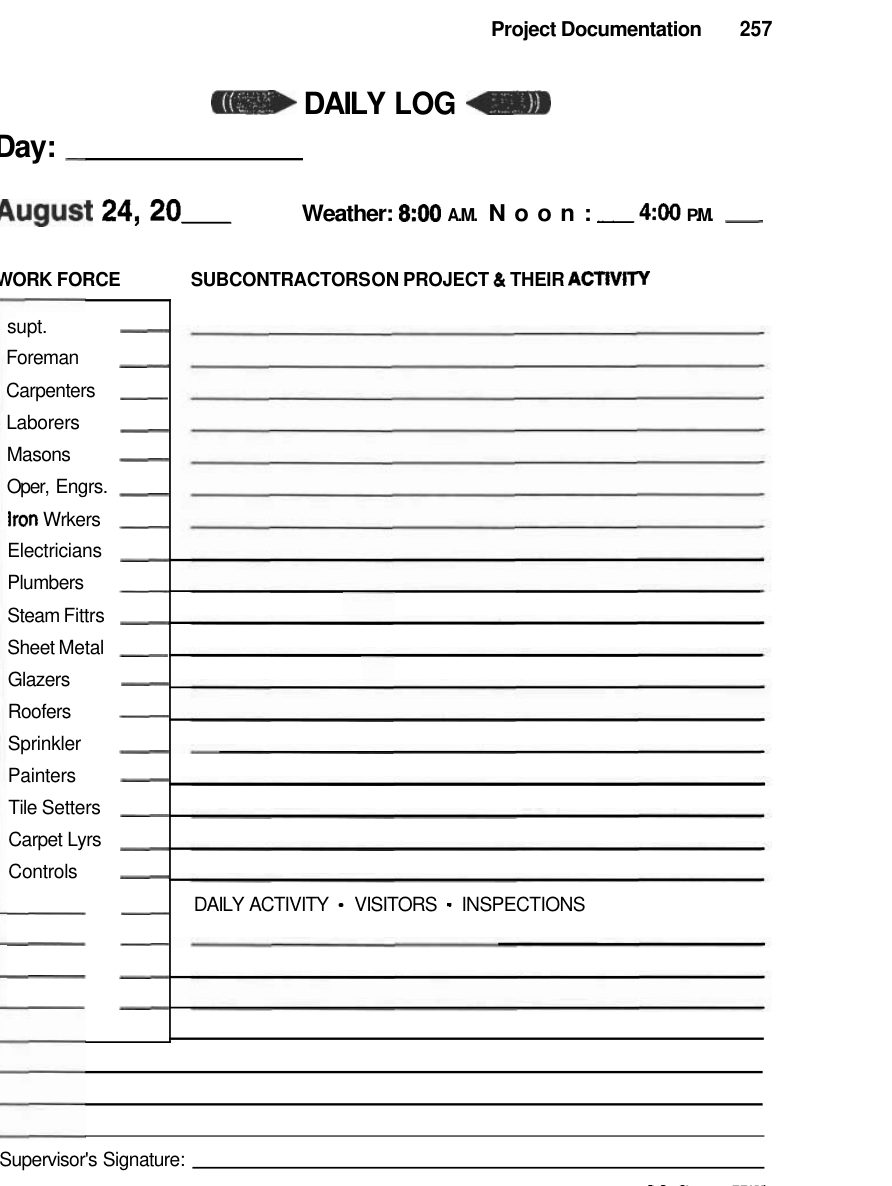
Their rule for claims is documentation, and the core record is the daily job log. Each entry records the date, weather, workers by craft, equipment by type, activities started and finished with quantities, subcontractors on site, deliveries (including late or damaged ones), visitors and inspectors, meetings and decisions, problems, and corrective steps. To be accepted as evidence, entries must be original, made on the date shown in the regular course of business, based on the writer’s own knowledge, and kept in a bound book or an equivalently secure electronic system. Entries should state facts without opinion or emotion.
For railroad work: The inspector’s daily report on a railroad job should add the items that drive most disputes there: the track window granted versus planned, with start and stop times; flagging availability; train delays and slow orders in effect; and quantities of undercut, unsuitable material removed and fill placed by station. When the subgrade exposed in an undercut differs from the boring logs, photograph it, note the stations and depths, and notify the railroad’s representative the same day. Then run the “with and without change” schedule comparison before the next window is booked.
Source: Sears, S. K., Sears, G. A., Clough, R. H., Rounds, J. L., and Segner, R. O., Jr. (2015). Construction Project Management: A Practical Guide to Field Construction Management, 6th ed. Hoboken, NJ: John Wiley & Sons, pp. 328–332. Summarized and paraphrased. Full reference under Supplemental References.
Levy (2007) treats documentation as part of the work itself and places his documentation chapter immediately before the one on claims for that reason. Good records are not volume; they are prompt, accurate entries made when important events happen. For any significant event he recommends recording what happened, when and how it happened, when it was discovered, whether responsibility can be assigned with certainty, who was notified and when, its impact, the immediate and longer-term actions required and by whom, and which party will resolve it. Facts should be separated from opinions; useful remarks at meetings can be noted separately to show intent.
The superintendent’s daily record is the backbone. Levy notes that a bound diary with daily entries meets the legal definition of a business record, while loose sheets may not, and suggests reviewing electronic logs with counsel. At a minimum each entry should give the date (with “No Work” on idle days); weather and temperature at start, midday and end of shift; each subcontractor on site with crew size, work and location; the firm’s own workforce and tasks; visitors and their purpose; inspections by agencies, testing labs or the engineer; work performed and where; deliveries with ticket numbers; unusual events and stoppages; and every accident, reportable or not.
Photographs document progress or lack of it, conditions that differ materially from those expected, support for change orders, and complex details. Levy recommends a tape or rule in close-ups for scale, and specifically lists rock, groundwater and buried debris as conditions to photograph even when they seem unlikely to matter contractually. His closing advice is simply: document, document, document.
For railroad work: The geotechnical field representative’s daily report on a subgrade rehabilitation, slide repair or culvert replacement should add railroad-specific fields: track and work-window times granted and released, the employee in charge or flagman, trains passed during the window, any slow order in effect, and lost window time with its cause. Photograph undercut subgrade, seepage, slip surfaces and unsuitable material in place with a scale and a station reference before it is removed or covered, and link each photo to the daily report and test locations.
Source: Levy, S. M. (2007). Project Management in Construction, 5th ed. New York: McGraw-Hill, pp. 229–230, 255–260. Summarized and paraphrased; figures reproduced for internal reference. Full reference under Supplemental References.
Goldbloom states a basic rule: responsibility for the result follows whoever prescribed the method. If a specification dictates how the work is done and the contractor follows it, the contractor is not liable for a bad result. His common bad example is embankment specifications that fix loose-lift thickness, compactor type and size, and number of passes, and then also demand a minimum in-place density. When the procedure is followed and the density is missed, the owner has no position. His recommended end-result approach is to:
Lift thickness, moisture, the dumping method, and the type and size of the compactor all affect the number of passes needed. That is why the means should be left to the contractor.
He also separates two functions:
Each technical section should say which tests the engineer will perform and by what method, so the contractor knows how acceptance will be judged. His cautionary example is a contract that made the contractor hire the testing laboratory for in-place density, batch-plant inspection and concrete cylinders. A lab paid by the contractor owes its first loyalty to the contractor, so this cannot serve as QA.
On tolerances, he notes that rigid wording such as “true to line and grade” leads to claims. In one spillway case the court allowed the contractor to recover the cost of forming to tolerances tighter than the finished structure required.
For railroad work: Ballast, subballast and subgrade QA/QC documentation should state for each item whether it is an end-result or a method requirement, and should not mix the two. When a method requirement is unavoidable, such as track-time-limited proof rolling or prescribed lift placement under a work window, write the acceptance criterion as conformance to that method. Keep acceptance testing (nuclear gauge, plate load, proof roll observation) with the railroad’s representative or its own consultant. Contractor testing should be identified as QC only. Give grade and cross-slope tolerances that track and drainage design can actually live with.
Source: Goldbloom, J. (1989). Engineering Construction Specifications: The Road to Better Quality, Lower Cost, Reduced Litigation. New York: Van Nostrand Reinhold, pp. 20–21, 183–184, 188. Summarized and paraphrased. Full reference under Supplemental References.
Anglin works through the general-conditions clause on concealed or unforeseen conditions, quoting AIA A201 (Article 5.3.4), and illustrates it with a case from his own practice. The clause recognizes two types:
Whoever observes the condition must give notice promptly, before it is disturbed, and in any case within 21 days. The architect or engineer then investigates. If the condition does differ materially, a change follows; if not, the reasons must be given in writing. Anglin stresses giving written notice of cost or delay even before the amount is known. A continuing delay needs to be documented only once.
In his fire-college case, excavation for a new building uncovered a fire line that turned unexpectedly under the footprint. The contractor took these steps:
The owner argued that a plan note required the contractor to field-verify utilities. The contractor answered that, under the contract, studying the documents is meant to facilitate construction, not to discover errors. He also showed that no one had specified a particular sequence of excavation. The owner paid.
For railroad work: on subgrade, slope and culvert jobs, the geotechnical field representative is usually the first to see the condition. Typical examples are:
The daily report should record:
Railroad and agency contracts set their own notice periods and procedures, so put them in the field instructions before work starts.
Source: Anglin, G. (2020). Introduction to Estimating, Plan Reading and Construction Techniques. Abingdon: Routledge, pp. 381–382, 387–390. Summarized and paraphrased. Full reference under Supplemental References.
Disturbed ground erodes fastest in the months between clearing and permanent stabilization. Federal and state stormwater rules require a construction stormwater permit for most projects that disturb one acre or more, with a stormwater pollution prevention plan (SWPPP) describing the site, the controls and the inspection schedule.
Natural (vegetative) methods: keep existing vegetation where possible; seed and mulch exposed slopes promptly; use erosion control blankets on steep or long slopes.
Structural methods:
For railroad work: On railroad work the ditch line is the drainage system for the track, so sediment that leaves a construction area fouls ballast and blocks the ditches and culverts the track depends on (Chapter 2.1, Section 2.1.5; Chapter 2.3). Stabilize new embankment slopes and widened shoulders quickly, place ditch checks before the first storm rather than after it, inspect controls after rain, and remove sediment before it is washed into culverts. Size outlet protection with Section 3.5.11.
Source: Goswami, I. (2015). Civil Engineering All-In-One PE Exam Guide: Breadth and Depth, 3rd ed. New York: McGraw-Hill Education, Chapter 508, Erosion Control. Full reference under Supplemental References.