
Geotechnical engineering libraryContact
Where n = 0.5 for clean sand; n is refined iteratively using the soil behavior type index I_c (Robertson & Wride 1998):
Robertson and Wride (1998): start with n = 1.0 and compute I_c. If I_c > 2.6, keep n = 1.0. If I_c ≤ 2.6, recompute with n = 0.5; if I_c is then above 2.6, use n = 0.75. Robertson (2009) gives a continuous form, n = 0.381 I_c + 0.05(σ'_v/P_a) − 0.15 ≤ 1.0.
Values from these correlations are estimates, not test results. State the equation ID and source when one is used, confirm the soil or rock is within its range, and calibrate against site testing before design.
| Symbol | What it is | Comes from | How to get it | Typical range |
|---|---|---|---|---|
| qc1N | CPT tip resistance = C_Q ⋅ q_c P_a | Field test | Cone penetration test with pore pressure (CPTu, ASTM D5778). | loose sand 20–40, dense 120–200 tsf · by USCS group |
| CQ | intermediate value computed on this page | Another equation | Computed: C_Q = ( P_a σ'_v )^n | project-specific |
| n | 0.5 for clean sand | Chart, table or correction factor | Read from the cited chart or table for the site conditions; values listed in the definition. | project-specific |
| Ic | CPT tip resistance = √ (3.47 - log Q_t)^2 + (1.22 + log F_r)^2 | Field test | Cone penetration test with pore pressure (CPTu, ASTM D5778). | loose sand 20–40, dense 120–200 tsf · by USCS group |
| Qt | CPT tip resistance = q_t - σ_v P_a ⋅ ( P_a σ'_v )^n | Field test | Cone penetration test with pore pressure (CPTu, ASTM D5778). | loose sand 20–40, dense 120–200 tsf · by USCS group |
| Fr | CPT tip resistance = f_s q_t - σ_v × 100% | Field test | Cone penetration test with pore pressure (CPTu, ASTM D5778). | loose sand 20–40, dense 120–200 tsf · by USCS group |
| σ'v | vertical stress / pore pressure | Another equation | From unit weights, layer thicknesses and the groundwater level: σv = Σγihi, u = γw × depth below the water table, σ' = σ − u. Use the design groundwater level. | project-specific |
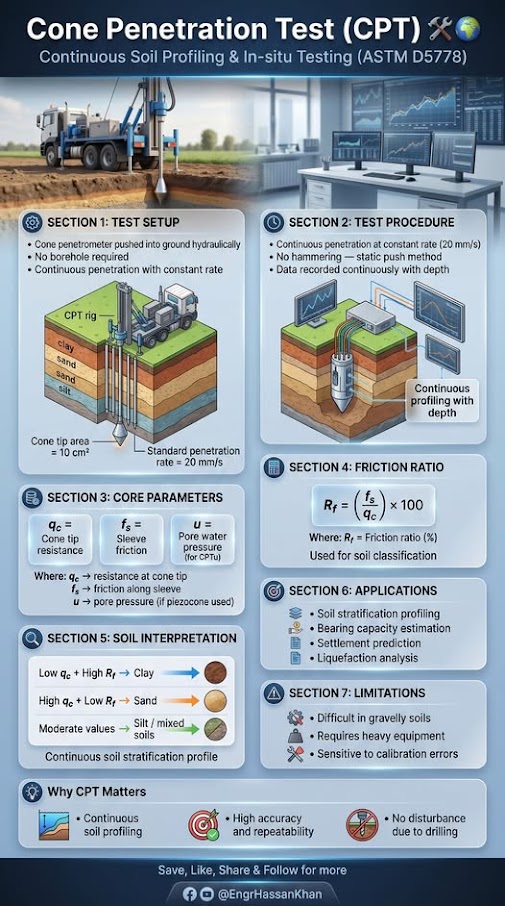
Robertson and Wride (1998). Soils with Ic > 2.6 are generally treated as too clay-like to liquefy, subject to sampling and testing.
| Symbol | What it is | Comes from | How to get it | Typical range |
|---|---|---|---|---|
| (qc1N)cs | clean-sand normalized tip resistance = K_c · q_c1N | Field test | Cone penetration test with pore pressure (CPTu, ASTM D5778). | loose sand 20–40, dense 120–200 tsf · by USCS group |
For (q_c1N)_cs ≥ 160, the soil is non-liquefiable.
| Symbol | What it is | Comes from | How to get it | Typical range |
|---|---|---|---|---|
| CRR7.5 | intermediate value computed on this page | Another equation | Computed: CRR_7.5 = 0.833 ⋅ (q_c1N)cs 1,000 + 0.05 for (qc1N)_cs < 50 | project-specific |