
↑ Parent Menu⌂ Main Menu
← Chapter 7.3 Pavement Subgrade Evaluation
GHRM
Railway Ground Hazard Risk Management · 7.0 · Design
Sections · click a car to open it

7.3.7 Intermodal Yard Crane Rail Foundation Subgrade

Pavement subgrade evaluation for railroad facilities encompasses two distinct but related infrastructure domains: (1) paved surfaces within railroad right-of-way —…
Authors: Daniel P. Colwell and Mario Ruel
7.3.7 Intermodal Yard Crane Rail Foundation Subgrade

Rail-mounted gantry cranes (RMG) impose wheel loads of 75–150 kips per wheel on crane rail foundation beams. The geotechnical design challenge is controlling differential settlement between adjacent crane rail beam pile caps:

Differential settlement criterion:

Δ Sallow = Lspan500    (crane rail alignment tolerance)

For a 50-ft span between crane rail beam pile caps: ΔS_allow = 50 × 12 in. / 500 = 1.2 in. maximum differential. Some owners tighten this to L/750 (0.80 in.) for high-cycle operations. Rubber-tired gantries (RTG) run on paved runways rather than rails, so their runways are designed as heavy-duty pavement.

Crane rail foundation design is addressed in Chapter 6.1 (bearing capacity) and Chapter 6.2 (settlement). The subgrade evaluation output for crane rail areas includes:

  • Subgrade CBR (minimum 10 for unpaved laydown zones; 15 for crane lane shoulders)
  • Settlement profile under crane wheel loads (Boussinesq stress distribution at depth)
  • Differential settlement estimate between pile cap locations
  • Subgrade variability assessment (coefficient of variation of CBR along crane runway ≤ 25%)

Case study: 7.3.15.3 Temporary haul road for a one-off heavy load (Look 2023), in §19.15 Case Studies.
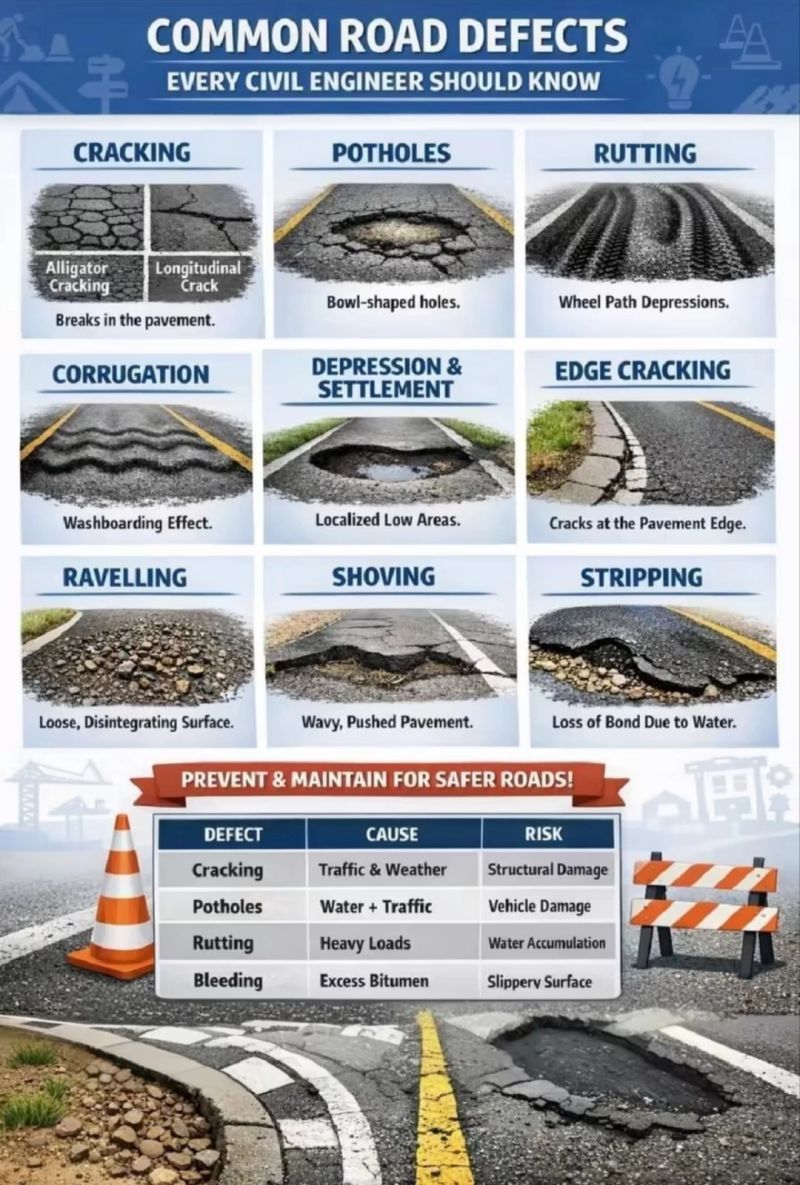
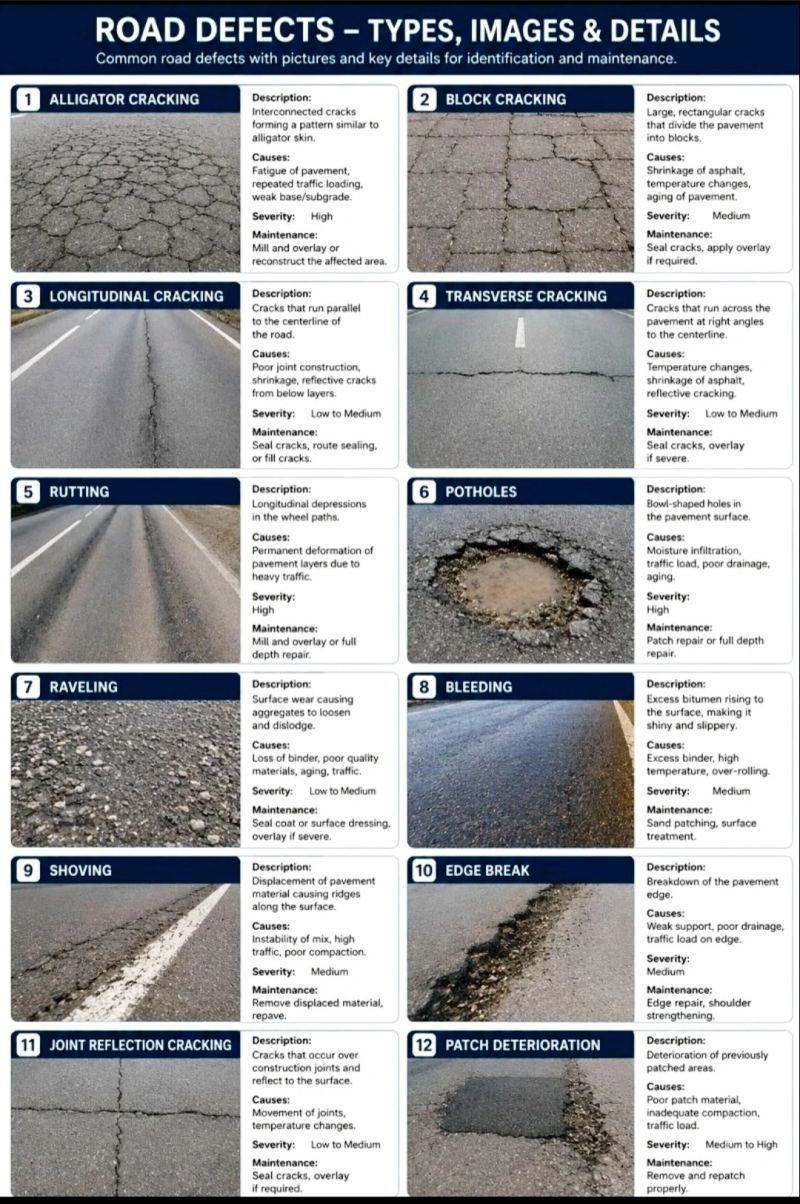
Common Road Defects
Common Road Defects
Road Defects
Road Defects
← Previous · 7.0 Design Chapter 7.2 — Ground Improvement Methods
Next · 7.0 Design → Chapter 7.4 — Earthworks Asset Management and Remedial Design