Plain text version Site Investigation Phase
[ ] Confirm finished-grade elevation from grading plan before scheduling test pits [ ] Excavate test pits to Z_f + 3 ft depth at northern facilities [ ] Collect undisturbed (Shelby tube) or bulk samples at 1-ft intervals to subbase depth [ ] Measure depth to groundwater and document seasonal high-water table records [ ] Test for sulfate content (ASTM D4327 ) at all sites where lime stabilization is planned [ ] Photograph and log each test pit with USCS classification and frost susceptibility group noted Laboratory Testing Phase
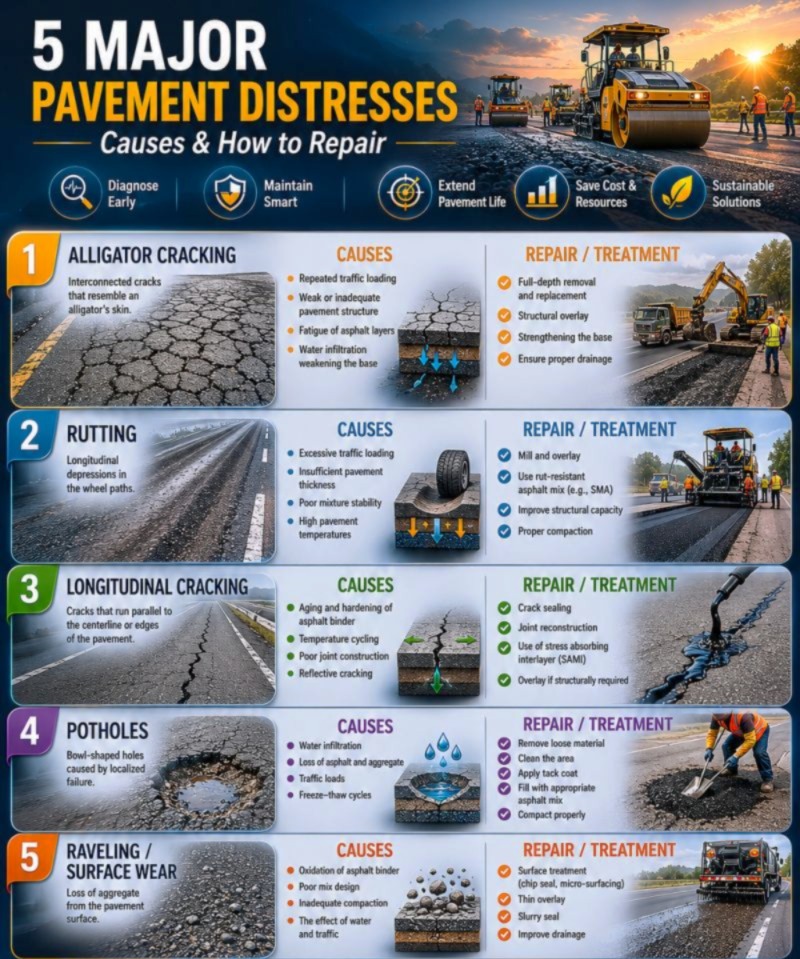
[ ] Run Modified Proctor (ASTM D1557 ) for all subgrade materials intended for compaction [ ] Perform soaked CBR at 95% Modified Proctor RC (ASTM D1883 ) [ ] Run Atterberg Limits (ASTM D4318 ) on all fine-grained samples [ ] Run grain size analysis (ASTM D7928 / D6913) with P-200 determination on all samples [ ] Confirm frost susceptibility classification per Table 7.3-5 for all samples in frost zones [ ] Test lime or cement-stabilized specimens for CBR at 7-day cure (if stabilization is proposed) [ ] Conduct sulfate test if PI > 20 or existing lime treatment has shown distress 5 Major Pavement Distress Design Phase
[ ] Calculate design ESAL for target traffic (reach stackers, truck tractors, service vehicles) [ ] Select reliability R and S₀ per the owner railroad's standard [ ] Confirm design M_r from soaked CBR; apply the AASHTO seasonal effective M_r if frost zone [ ] Calculate SN (flexible) or D (rigid) per AASHTO 1993 [ ] Design layer thicknesses using layer coefficients (Table 7.3-4) and drainage coefficients [ ] Check crane runway differential settlement criteria separately from pavement SN [ ] Specify compaction criteria per Table 7.3-6 for client [ ] Specify subgrade stabilization scope and method if CBR < client minimum Deliverable Phase
[ ] Provide test pit logs with CBR, M_r, FS class, and USCS symbol for each sample [ ] Include pavement design calculation summary (AASHTO inputs and SN/D result) [ ] Include typical pavement cross-section detail with annotated layer materials and thicknesses [ ] Provide subgrade improvement specification (lime, cement, geosynthetic) if applicable [ ] Provide frost design calculations (Z_f, seasonal M_r) for all northern facility sites [ ] Provide subgrade baseline data table formatted for client's pavement management system