
↑ Parent Menu⌂ Main Menu
← Chapter 6.1 Foundation Engineering: Bearing Capacity
GHRM
Railway Ground Hazard Risk Management · 6.0 · Analysis
Sections · click a car to open it

6.1.3 Eccentric Loading — Effective Footing Dimensions

Foundation bearing capacity governs the structural adequacy of every load-transfer element in railroad infrastructure — bridge abutments and piers, signal equipment…
Authors: Daniel P. Colwell and Mario Ruel
6.1.3 Eccentric Loading — Effective Footing Dimensions

Railroad abutment footings routinely carry eccentric loads due to moment from earth pressure, live load surcharge, and longitudinal braking. The effective area method (Meyerhof 1953) reduces the footing dimensions to eliminate tension:
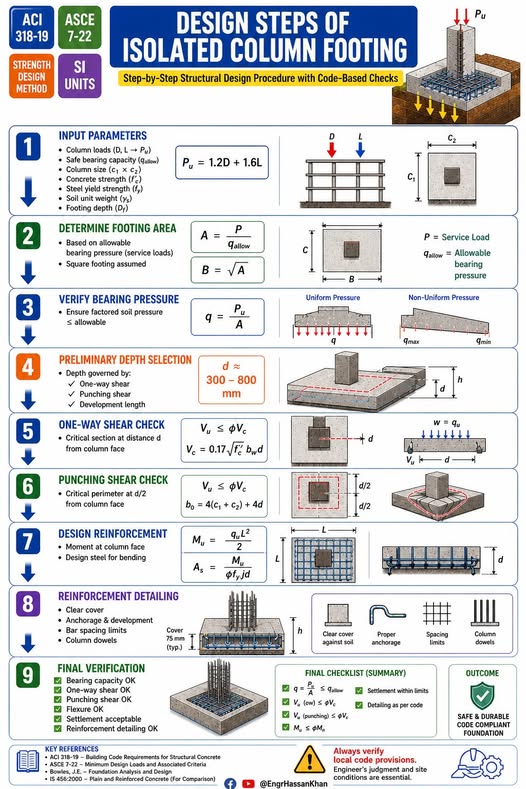
Design of Isolated Footing
Isolated Footing
Isolated Footing
Equation 6.1-7 — Effective Dimensions:

B' = B − 2·e_B

L' = L − 2·e_L

Where e_B = M_B / P and e_L = M_L / P are eccentricities (ft) computed from resultant moments about the footing centroid. AREMA MRE Chapter 8 requires that the resultant fall within the middle third of the footing (e ≤ B/6) for unfactored loading.

Bearing capacity calculations use B' and L' in all equations; settlement analysis (Chapter 6.2) uses the full B and L for stress distribution.
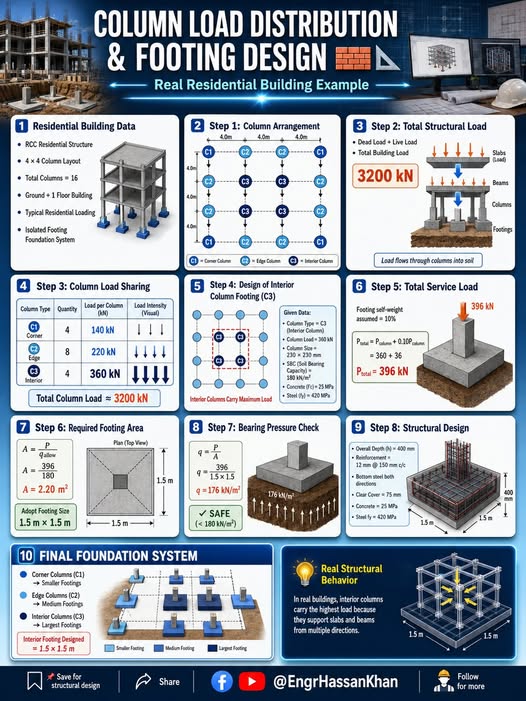
Column Load Distribution
← Previous · 5.0 Testing Chapter 5.5 — The Observational Method and Trigger-Action Response Plans
Next · 6.0 Analysis → Chapter 6.2 — Settlement Analysis