Geotechnical engineering libraryContact
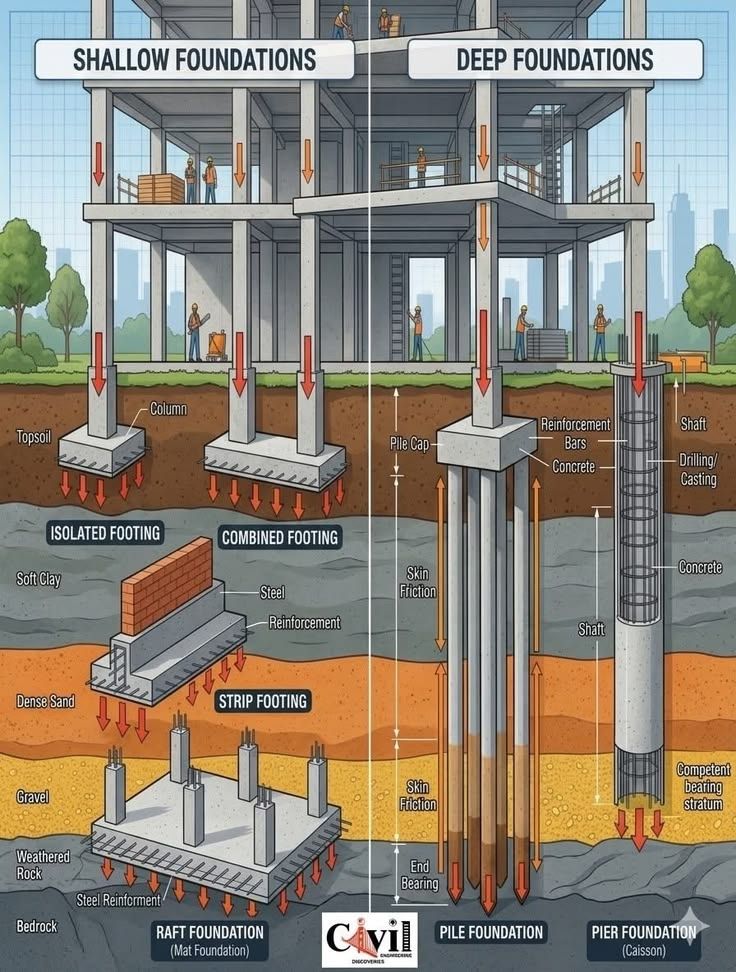
Foundation bearing capacity governs the structural adequacy of every load-transfer element in railroad infrastructure — bridge abutments and piers, signal equipment foundations, grade crossing slabs, retaining wall footings, building slabs at intermodal yards, and pile-supported overhead structures. This chapter develops the complete bearing capacity framework for shallow and deep foundations under railroad loading, applying the Vesić generalized bearing capacity equation to strip, rectangular, and circular footings; eccentric and inclined loading from longitudinal braking and lateral wind; and pile capacity by the α-method (cohesive soils), β-method (cohesionless soils), and Meyerhof SPT-based method. Cooper E-80 live loads with client-specific dynamic amplification factors are translated into equivalent static foundation pressures. Worked examples address a spread footing under a Class I railroad bridge abutment, a drilled shaft at a Class I railroad bridge pier, and a pile group at a Class I railroad intermodal crane rail. Owner railroads impose unique requirements for minimum factors of safety, pile type preferences, and structural review coordination; these are integrated throughout. Cross-references are provided to Chapter 6.2 (Settlement Analysis), Chapter 6.3 (Slope Stability), Chapter 6.5 (Seismic/Liquefaction), and Chapter 2.3 (Railroad Track Subgrade).