Geotechnical engineering library
Contact
Home
GHRM
LEVI
↑ Parent Menu
⌂ Main Menu
← Chapter 5.1 In Situ Testing
GHRM
Railway Ground Hazard Risk Management · 5.0 · Testing
Sections · click a car to open it
5.1.11 Reference Photographs
In situ testing provides continuous or near-continuous soil and rock characterization without the inherent sample disturbance associated with laboratory testing.
Authors:
Daniel P. Colwell
and
Mario Ruel
Executive Summary
Empirical Equations — Use and Limitations
5.1.0 In Situ Test Catalogue: What Each Test Provides and How It Is Used
5.1.1 Background and Role of In Situ Testing in Railroad Investigations
5.1.2 Cone Penetration Test (CPT and CPTu)
5.1.3 Vane Shear Test (VST)
5.1.4 Pressuremeter Test (PMT)
5.1.5 Flat Dilatometer Test (DMT)
5.1.6 Multichannel Analysis of Surface Waves (MASW)
5.1.7 Seismic Refraction
5.1.8 Method Comparison and Selection Guide
5.1.9 Worked Examples
5.1.10 Representative In Situ Test Data Table
5.1.11 Reference Photographs
5.1.12 Practical Recommendations
5.1.13 Field Operations Checklist — In Situ Testing
5.1.14 Practice Questions
Cross-References
5.1.15 Ground Penetrating Radar Layer Interpretation
5.1.16 Borehole Geophysical Logging
5.1.17 Surface Geophysical Methods: Matching the Method to the Target
Author and Sources
Supplemental References
← 5.1.10 Representative In Situ Test Data Table
Chapter 5.1 landing page
Full chapter
5.1.12 Practical Recommendations →
5.1.11 Reference Photographs
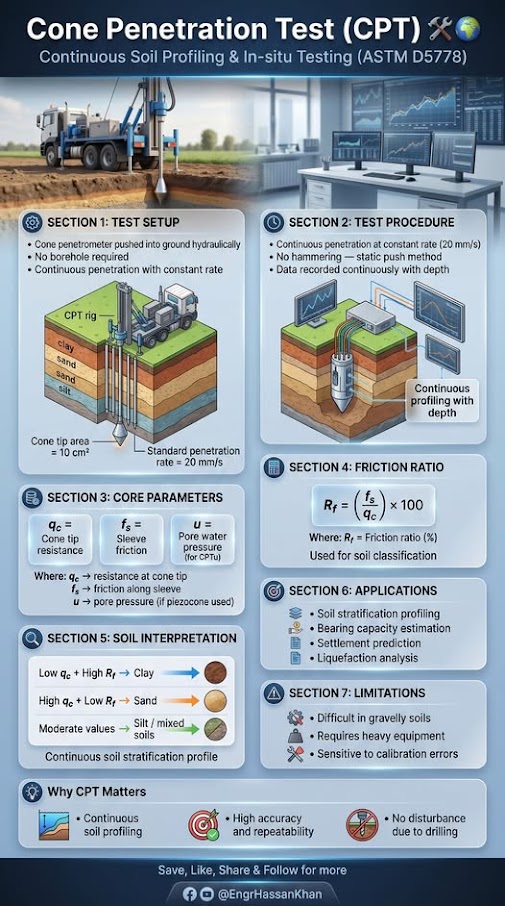
Cone Penetration Test
Vane Shear Test
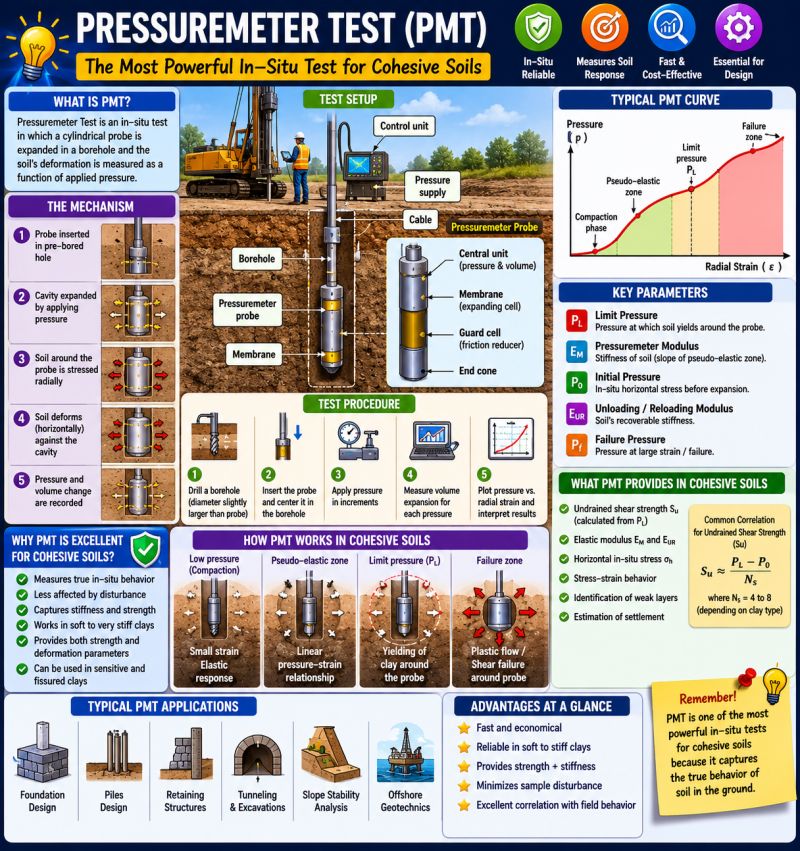
Pressuremeter Tests
← 5.1.10 Representative In Situ Test Data Table
Chapter 5.1 landing page
Full chapter
5.1.12 Practical Recommendations →
← Previous · 4.0 Subsurface Exploration
Chapter 4.1 — Borings and Sampling
Next · 5.0 Testing →
Chapter 5.2 — Laboratory Testing Program
×
Click image to zoom · Esc to close
Image could not be loaded.
‹
−
100%
+
Fit
1:1
›
×
Scroll or pinch to zoom · drag to pan · double-click to zoom in/out · arrow keys pan when zoomed