
Geotechnical engineering libraryContact
Railroad embankments, bridges, culverts, and intermodal facilities impose repetitive dynamic loads that sensitize soft or marginally competent soils in ways that static design loads alone do not capture. The Cooper E-80 live load equivalent used by Class I railroads combined with dynamic load factors (DLF) of 1.2 to 1.5 (see Introduction, Table 1.0-3) means that subgrade characterization must resolve not only static strength and stiffness but also cyclic response. In situ testing is indispensable for this because:
Access under traffic limits most in-situ tests to the shoulder or a track window. McHenry and Rose (2012) summarize the tools that can be run from the track or crib: the dynamic cone penetrometer and the instrumented French PANDA (records blow energy and penetration to give dynamic cone resistance qd), the light weight deflectometer, the German DyStaFiT dynamic plate test, and rail-bound stiffness vehicles (Track Loading Vehicle, Portancemètre). They also note that seismic CPT is attractive for railroads because a small-strain modulus better reflects the small cyclic strains under train loads than a resilient modulus does.
Source: McHenry, M. and Rose, J. (2012). Railroad Subgrade Performance Indicators — A Review of Available Testing Methods. University of Kentucky
Profillidis reproduces a matrix of in situ test methods (from Carter and Bentley, Correlations of Soil Properties) rating each method’s applicability to soil identification, profiling and engineering parameters across soil types. He notes that before 1960 the list would have held only the standard penetration test, the mechanical cone, the vane shear test and the plate load test. Today several methods can usually supply any given parameter, so the choice can be driven by soil type, depth and cost.
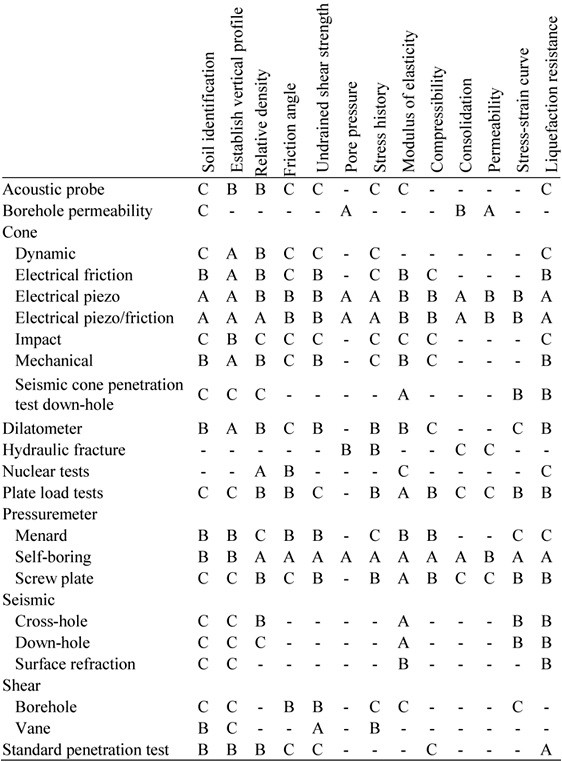
After Profillidis (2014), §9.2.3, Table 9.1; after Carter, M. and Bentley, S. (1991), Correlations of Soil Properties, Pentech Press. Full reference under Supplemental References.
Values from these correlations are estimates, not test results. State the equation ID and source when one is used, confirm the soil or rock is within its range, and calibrate against site testing before design.