
Geotechnical engineering libraryContact
Technical quality is necessary but not sufficient for a successful railroad geotechnical practice. How we communicate — the speed, format, and clarity of our client communications — determines whether the railroad can actually use our work in their decision process. Different railroad clients have different communication cultures; we adapt to each.
When we encounter a significant finding in the field — an unexpected organic layer at a structure location, rock at a depth that contradicts a prior boring, artesian groundwater conditions, or a condition that materially changes the geotechnical risk picture — we communicate it to the railroad project manager the same day, not in the formal report.
Routing findings to the owner railroad: Railroads differ in how field findings should reach them. Some expect a short, direct email to the Division Engineer or Roadmaster (three to five sentences: what was found, at what depth and location, what it means for the project, and what we recommend next). Others route findings through a designated project engineer or project manager, who passes them to track, structures or environmental reviewers, and prefer a formal preliminary memorandum for significant findings. Large networks often assign findings to a regional or division engineer for the territory rather than a central contact. Passenger railroads also need findings that affect train operations sent to operations management. On short lines, the subsidiary's general manager often needs to be copied, because track restrictions, crew deployments and customer notices are decided there. Confirm the communication chain at project initiation and record it in the project plan.
At the end of each day of field investigation work, we send a brief daily summary to the railroad project manager. This is non-negotiable professional practice on all railroad geotechnical programs, regardless of whether the client has specifically requested it. The daily summary is a single paragraph or a short bulleted list containing:
The daily summary is not a formal document and does not carry a PE seal. It is a professional service communication that keeps the client informed and demonstrates that our investigation is progressing as planned.
We notify the railroad project manager by email when we reach 75% of the not-to-exceed (NTE) budget on any task order. The notification states: the current budget, the amount expended to date, the work remaining, our current estimate of total cost at completion, and our recommendation for how to proceed — either confirm that remaining work will be completed within the current NTE, or request authorization to increase the NTE.
We do not wait for the client to ask about budget status. We do not complete work beyond the NTE without prior written authorization. These are fundamental PSA disciplines that the railroad client's accounts payable and capital program management departments enforce regardless of how important the additional work is technically.
The CIOB Code defines change broadly: anything that affects the scope or brief, cost (including whole-life cost), time milestones, risk allocation, the working of the team, or any project process. It sets out a single route for every change:
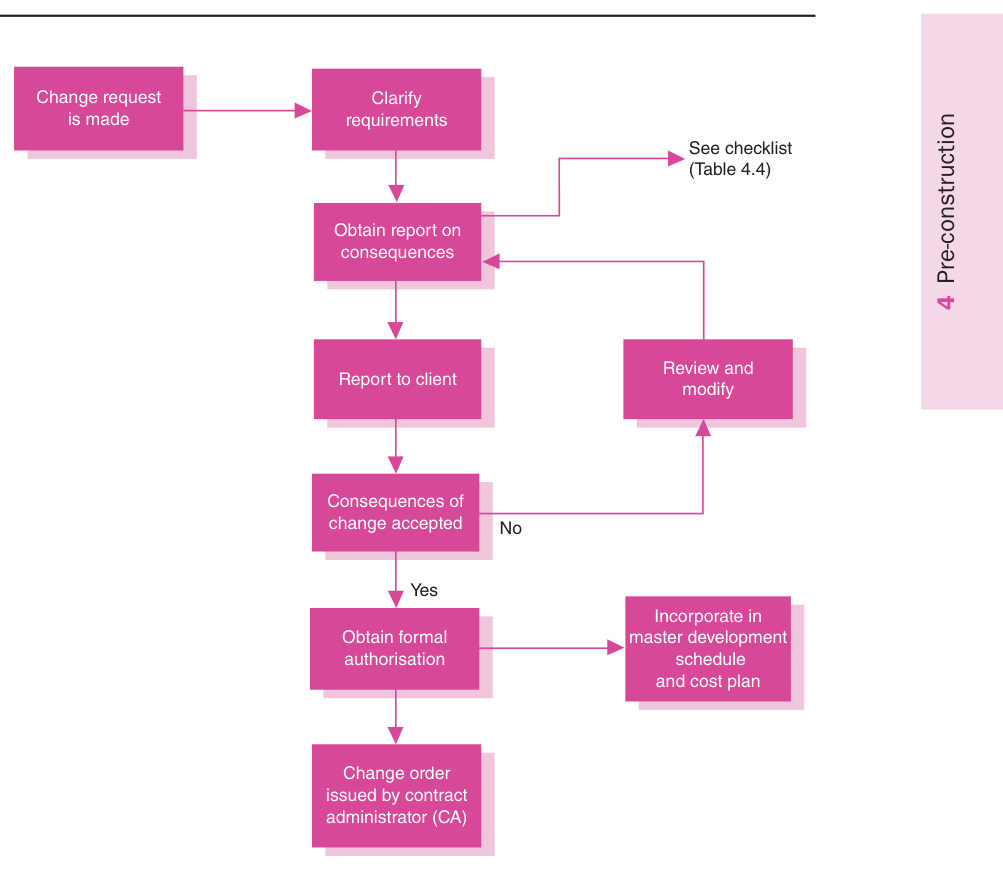
Supporting tools:
The Code stresses that controlling change during design is far more effective than during construction, and that time is often more expensive than the material change itself.
For railroad work: On consulting assignments for a railroad, agree at the kick-off:
Keep a simple change register on the project. Log each scope change (a new boring offset because of a signal cable, a CPT replaced by a boring because of refusal, an added cross-section after a new tension crack) with its cost and schedule effect. Send the register with each progress report. The railroad then sees the cumulative effect before the invoice does.
Source: Chartered Institute of Building (2014). Code of Practice for Project Management for Construction and Development, 5th ed. Chichester, UK: John Wiley & Sons, pp. 184–186, 236–238. Summarized and paraphrased; figures reproduced for internal reference. Full reference under Supplemental References.