
Geotechnical engineering libraryContact
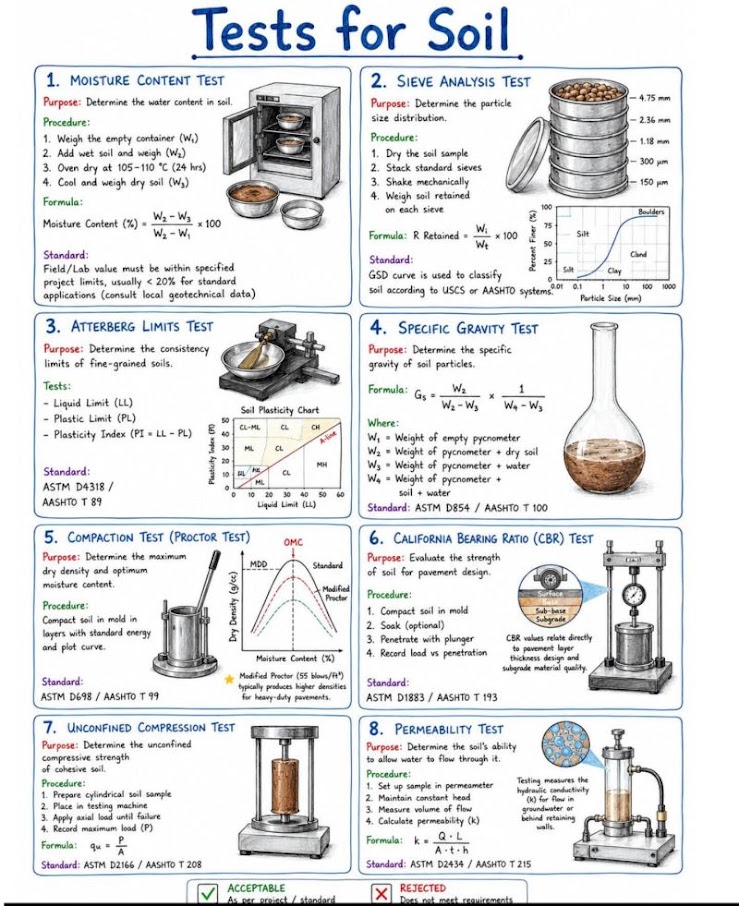
Laboratory testing must be assigned during planning — not after borings are complete. The testing matrix is organized by project feature, governing design calculation, and required test data.
| Feature | Design Calculation | Required Tests | Typical Quantity |
|---|---|---|---|
| Track subgrade — embankment | Settlement, bearing capacity | MC, Atterberg limits, USCS classification, consolidation | 1 consolidation per soft layer identified |
| Track subgrade — cut | Slope stability, shrink/swell | MC, Atterberg limits, unconfined compression (q_u), direct shear | 2–3 q_u per cut |
| Bridge abutment — spread footing | Bearing capacity, settlement | MC, Atterberg limits, consolidation, unconfined compression | Full suite per 5 ft depth change in critical strata |
| Bridge abutment — pile | Skin friction, end bearing | MC, Atterberg limits, triaxial UU (φ, c), grain size | Per critical layer |
| Intermodal pavement | Pavement subgrade design | MC, Atterberg, CBR (ASTM D1883), M_r (AASHTO T 307) | 1 CBR per lift zone |
| Crane rail foundation | Settlement, bearing capacity | MC, Atterberg, consolidation, triaxial CU | Full suite per 10 ft in critical zone |
| Retaining wall | Earth pressure, stability | MC, Atterberg, direct shear (φ', c'), unit weight | 1 direct shear per soil unit |
| Slope stability | Shear strength | Triaxial CU + CD, direct shear (residual φ_r for existing landslides) | 3+ per failure surface soil unit |
| Ground improvement | Settlement after treatment | MC, Atterberg, consolidation, grain size for PVD drain design | Full suite per 5 ft in soft zone |
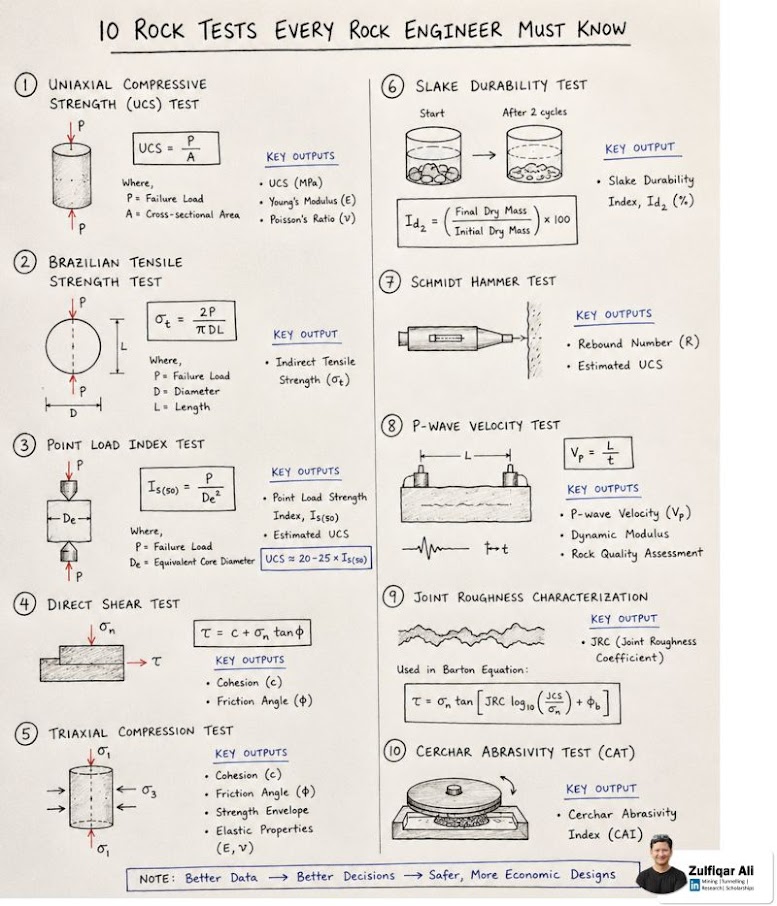
| Rock core (all structures) | Rock quality, bearing capacity | Point load (q_u conversion), core description (RQD), petrographic | 1 point load per 5 ft of core |
Values from these correlations are estimates, not test results. State the equation ID and source when one is used, confirm the soil or rock is within its range, and calibrate against site testing before design.