
Geotechnical engineering libraryContact
Planning a geotechnical investigation for a railroad client is not overhead — it is a professional service that prevents costly scope errors and keeps the investigation aligned with the design question the railroad's engineering department needs answered. On railroad programs that operate under Professional Services Agreements (PSA), planning is typically the first deliverable under a task order: a written Investigation Plan or Boring Plan memorandum that the railroad project manager reviews and approves before field work begins.
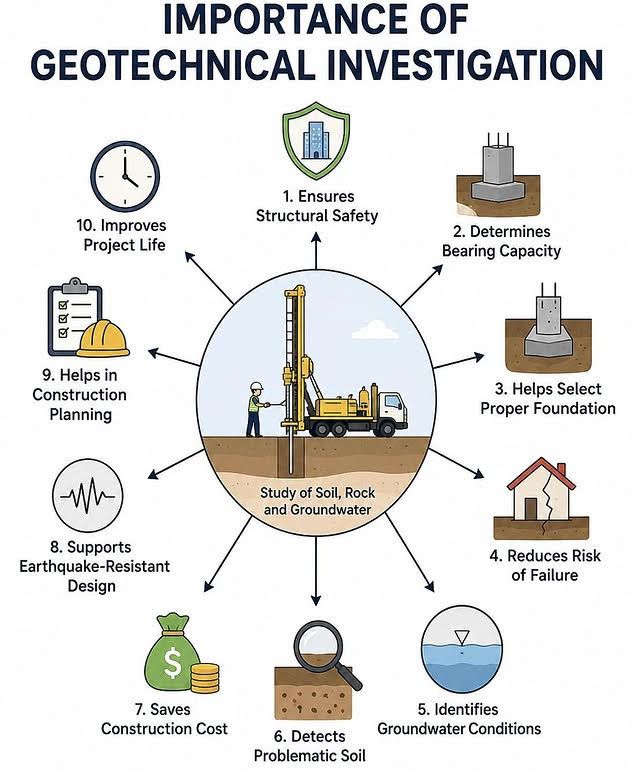
USACE EM 1110-1-1804 §2-1 defines the objective of a geotechnical investigation as obtaining information that permits design of a safe and economic structure. This definition translates directly to railroad practice: every boring, every sample, and every laboratory test must be traceable to a specific design parameter needed by the railroad's engineering team.
The most common planning failure in railroad geotechnical work is designing the investigation around what is convenient to access rather than what the design requires. A convenient boring is one that can be reached with standard drill rig access from a paved road or an open field. But the critical foundation condition for a railroad bridge abutment, retaining wall, or track embankment is often in a location that requires a track window, specialty equipment, or an ROW access permit — not a convenient open-field location. We plan investigations around the design question first; we solve the access problem second.
Table 5-S3. Site investigation cost as a percentage of project cost (Rowe, 1972, in Look, 2007)
| Type of work | % of capital cost | % of earthworks & foundation cost |
|---|---|---|
| Earth dams | 0.89–3.30 | 1.14–5.20 |
| Railways | 0.60–2.00 | 3.5 |
| Roads | 0.20–1.55 | 1.60–5.67 |
| Bridges | 0.12–0.50 | 0.26–1.30 |
| Embankments | 0.12–0.19 | 0.16–0.20 |
| Overall mean | 0.7 | 1.5 |
Railways sit near the top of the range. Look recommends budgeting no less than 0.2% of capital cost, notes that laboratory testing is typically only 10–20% of investigation cost, and warns against the competitive-bid trend of cutting lab testing and inferring design parameters from field classification alone. In Look’s relative risk ranking, rail embankments and railway bridges are rated higher-risk developments than road embankments and highway bridges.
Source: Look, B. G. (2007). Handbook of Geotechnical Investigation and Design Tables. Taylor & Francis
Case study: 3.9.14.1 No investigation: “the site across the road is the same” (Look 2023), in §5.14 Case Studies.
Miller argues that a project plan should be organized around deliverables rather than activities, because the client cares about what the project hands over, not the list of tasks performed. Deliverables are written as nouns. They are arranged in a product breakdown structure (PBS), the top component of the WBS, drawn either as an organization chart or as an indented outline. The single topmost deliverable is level zero; each lower level is produced by successive decomposition of the level above.
A complete PBS holds three kinds of deliverables:
The fourth level is usually enough detail to control the work. Go deeper where a deliverable is subcontracted (the subcontractor defines two further levels below it), where the deliverable is unfamiliar to the team, or where a team member is unknown to the manager. Miller rejects arbitrary rules such as “no activity longer than 40 hours”; each lowest-level deliverable should define one complete activity. His worked example decomposes a one-day recognition event for 400 employees through Events → Children’s Program → Rides → individual rides.
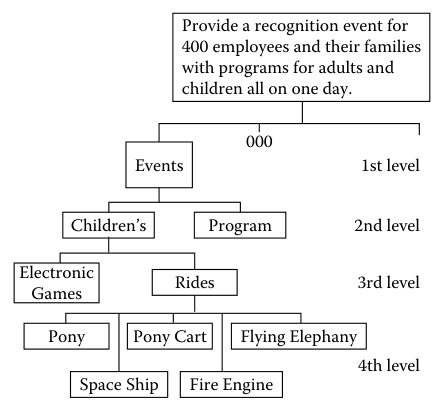
For railroad work: make level zero the thing the railroad is buying, for example “Geotechnical data report and repair recommendations, embankment at MP 112.4.” Level 1 legs might be Field Data, Laboratory Data, Analyses, Reports, Process Deliverables and Client Deliverables. Put the railroad’s obligations on the client leg: right-of-entry and track-access approval, track time and flagging or other roadway worker protection, utility and signal cable records, as-built drawings and the slow-order and maintenance history of the site. Group the safety plan, job-briefing plan, boring location plan, drilling subcontract and chain-of-custody procedure on the process leg. Because drilling is normally subcontracted, have the driller break the drilling deliverable into two more levels (mobilization, each boring log with its sample set, grouting records). A PBS of this kind also makes a clear scope exhibit for the proposal and shows the client exactly what each fee line produces.
Source: Miller, D. P. (2009). Building a Project Work Breakdown Structure: Visualizing Objectives, Deliverables, Activities, and Schedules. ESI International Project Management Series. Boca Raton, FL: Auerbach Publications (CRC Press, Taylor & Francis Group), pp. 23–25, 31–33, 45–49. Summarized and paraphrased; figures reproduced for internal reference. Full reference under Supplemental References.
Oberlender frames every project as passing through owner’s study, preliminary engineering, detailed design, procurement and construction. His central argument, shown as two opposing curves, is that the ability to influence quality, cost and schedule is highest at the start and falls steadily, while the cost of implementing a change is lowest at the start and rises steeply once procurement and construction begin. Savings are made early, not at the start of construction.
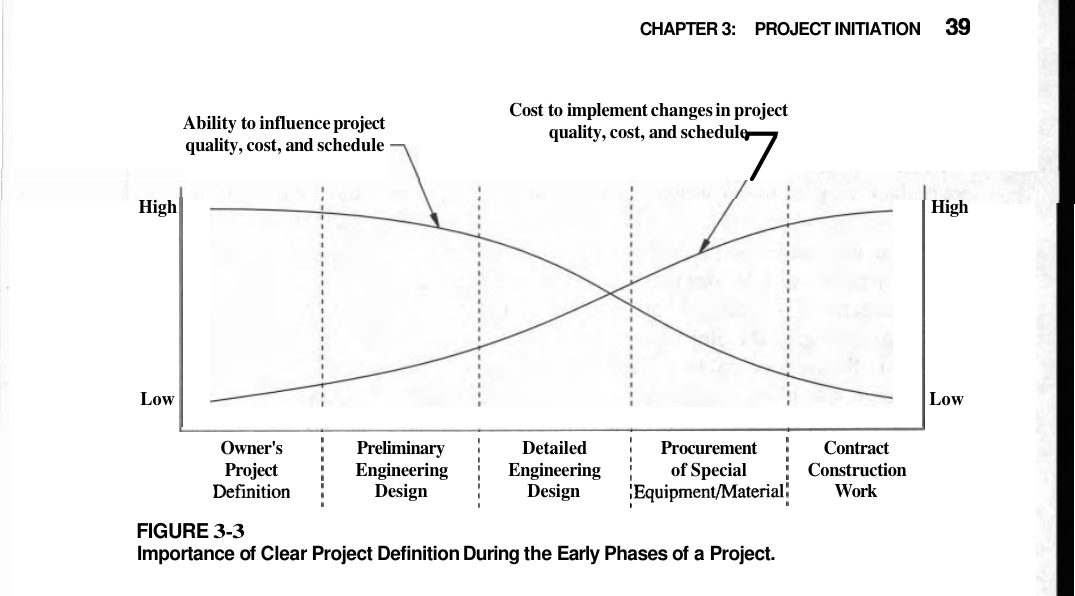
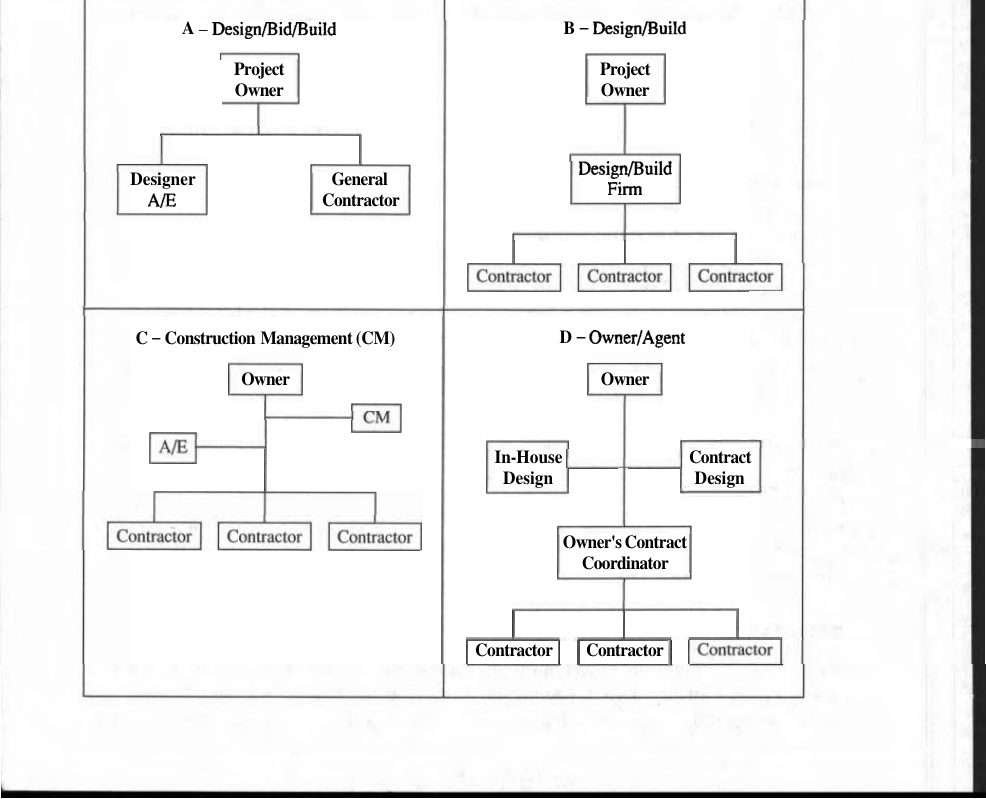
From this he draws several working rules:
He also cites the Construction Industry Institute’s Project Definition Rating Index (PDRI): 70 scope elements, each rated 1 (complete) to 5 (poor), weighted to a maximum of 1,000 points. In the CII study, projects that scored below 200 performed significantly better than those that scored above 200.
For railroad work: The geotechnical investigation sits at the high-influence end of the curve. Boring locations, depths and lab assignments are fixed while the repair concept (undercut and blanket, shear key, wall, ground improvement or culvert replacement) is still open. Once a track window is booked and materials are ordered, changing direction costs track time as well as money. Before mobilizing a drill rig, confirm with the railroad’s project engineer the purpose of the work, the performance target (for example, removing a slow order or meeting a settlement tolerance), the access and work-window constraints, and the not-to-exceed budget. Record any assumptions in the scope letter so that a later change, such as adding a culvert crossing or extending the limits after a new slip, is visibly a change and is priced as one.
Source: Oberlender, G. D. (2000). Project Management for Engineering and Construction, 2nd ed. Boston: McGraw-Hill, pp. 33–41, 119–121. Summarized and paraphrased; figures reproduced for internal reference. Full reference under Supplemental References.
Cretu, Stewart and Berends describe four estimate levels (planning, scoping, design, and final/letting), each with its own purpose, method and expected accuracy. The accuracy range narrows as design matures, but it is not symmetrical: the upper end sits much farther above the baseline than the lower end sits below it, and the upper end moves toward the baseline faster as project-specific information is gained. The authors read this as evidence that economic and political pressures push early numbers down, and they warn reviewers to watch for it. They place reasonably firm project definition at roughly 30 percent design. Before that point the estimate range is driven mostly by scope uncertainty; after it, by unit-cost and market uncertainty plus discrete risk events.
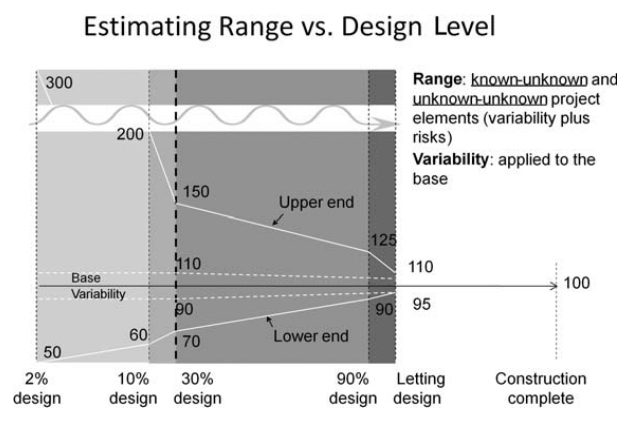
Their illustration uses a project that ends up costing $100 million. Read from their chart, the plausible range at about 2 percent design runs from roughly $50 million to $300 million, tightens to about $70–150 million at 30 percent, and is close to $95–110 million at letting. In the same way, the “miscellaneous item allowance” that covers undefined scope typically falls from 30–50 percent at planning, to 20–30 percent at scoping, to 10–20 percent during design, and to zero at letting, when every item should be defined. The authors also call for a written basis of estimate (BOE) that records scope, exclusions, assumptions, data sources and the threats and opportunities known when the estimate was made. They urge reporting early estimates as ranges, because the first number given is the one everyone remembers.
For railroad work: On subgrade rehabilitation, slide repair and culvert replacement projects, the upper tail of the estimate is driven mainly by ground conditions: depth to competent material, soft or organic foundation soils, groundwater, and the extent of fouled ballast or a failed subgrade layer. That makes the investigation the main way to pull the upper end down before the railroad sets a capital budget. When scoping a program, show the client the current estimate range, identify which geotechnical unknowns control its upper end, and describe how the proposed borings, CPT soundings or GPR would narrow it. Record the geotechnical assumptions behind each estimate in a BOE-style note, such as an assumed undercut depth, assumed rock line or assumed drainage outfall, so that later changes can be traced to new subsurface data rather than read as estimating error.
Source: Cretu, O., Stewart, R. and Berends, T. (2011). Risk Management for Design and Construction. Hoboken, NJ: John Wiley & Sons, pp. 18–25. Summarized and paraphrased; figures reproduced for internal reference. Full reference under Supplemental References.