
Geotechnical engineering libraryContact
| Phase | Class I Freight | Passenger | Short-line Short Line / Regional |
|---|---|---|---|
| Desktop Review | Required — all projects | Required — all projects | Required — recommended even for small projects |
| Assessment | Required if no prior data | Required — all projects | Required — client often has minimal prior data |
| Reconnaissance | Required for new alignments and facilities | Required — all projects | May combine with design investigation |
| Study / Prelim. Eng. | Required for new facilities; alternatives analysis | Required — all projects | Grant-funded projects require study level |
| 30% Design | Required | Required — owner railroad's process governs | Required |
| 60% Design | Required | Required — owner railroad's process governs | Required |
| 100% Design | Required | Required — owner railroad's process governs | Required |
| Construction Services | Required on significant capital; recommended on all | Required — continuous inspection on passenger corridor | Required on embankment and structure work |
The course presents the statement of work (SOW) as the document that defines scope, sets the customer’s expectations and can serve as the contract. A good SOW answers: what the purpose is and why the project is being done; who the immediate customer and the end user are; what the deliverables are and what support they need; and what the budget, final date, success measures, customer support and contingency plans are. Its generic contents are:
For railroad work: a culvert replacement investigation SOW might be built as follows (values illustrative):
Writing the client’s obligations into the SOW makes them visible when the schedule slips for reasons outside the consultant’s control.
Source: Skill Right (2013). Project Management Tools and Techniques: An Introductory Course in Project Management Foundations [training slides sponsored by Texas Instruments, Inc.; minor modifications by N. Santiago, Spring 2013 version], slides 26–35. Summarized and paraphrased. Full reference under Supplemental References.
Oberlender calls the work breakdown structure (WBS) the cornerstone of the work plan: to manage the whole project, you manage each of its parts. The WBS divides a project into levels (major facilities, sub-facilities, work items, tasks), and the lowest level is the work package, defined well enough to be measured, budgeted, scheduled and controlled. Code numbers link each package to the organizational breakdown structure (who does it), the cost breakdown structure (which account pays for it) and the CPM schedule (when it happens).
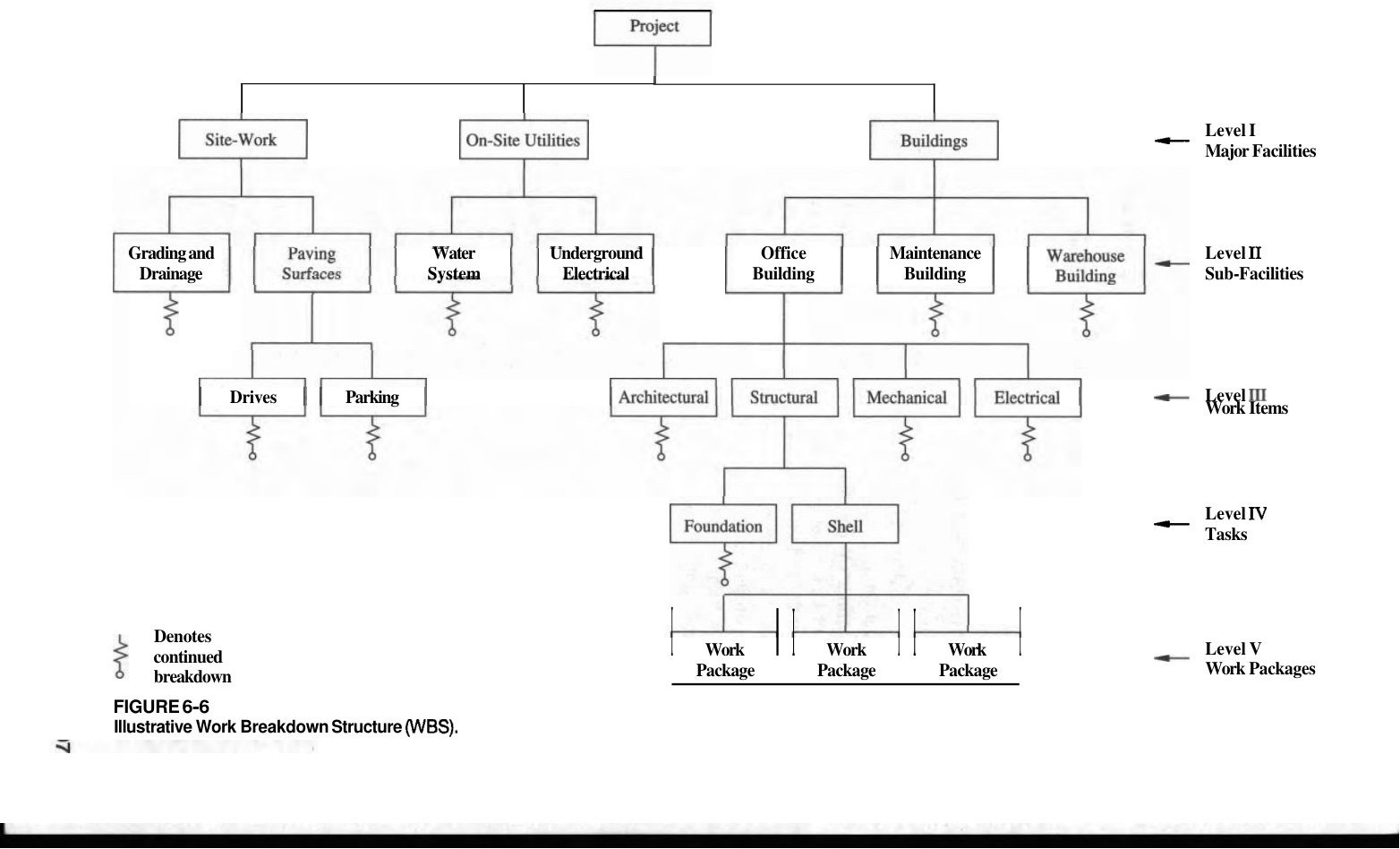
His procedure for building the plan:
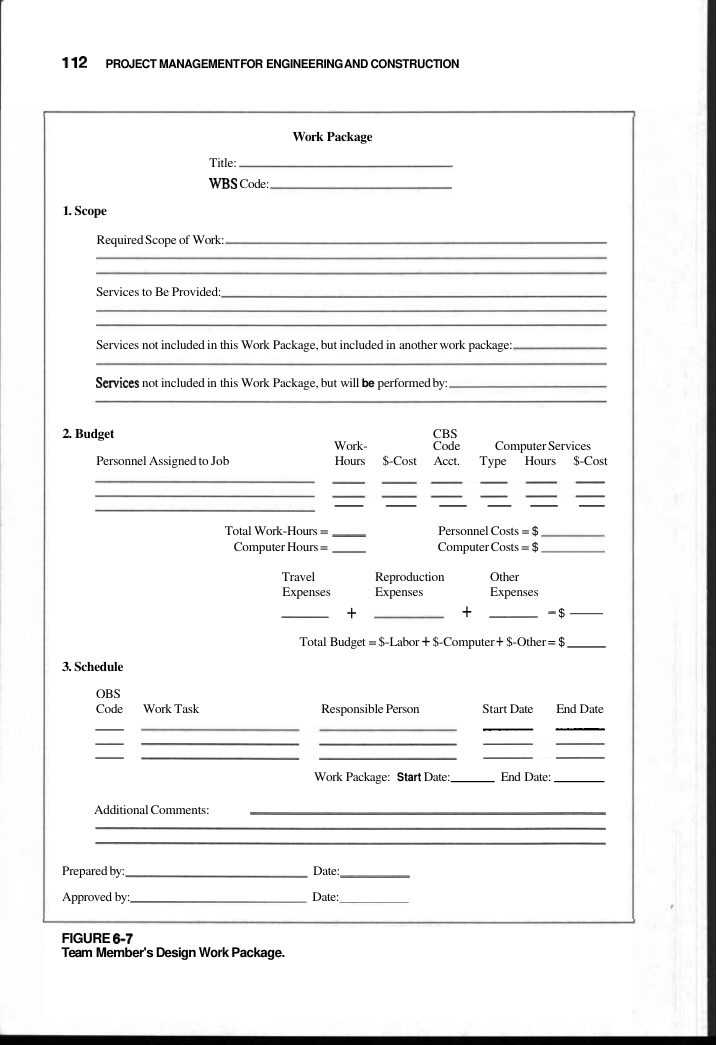
The “not included / performed by others” lines on the work package are what prevent the same work from being done twice, or not at all.
For railroad work: A typical geotechnical scope breaks down cleanly. Level I covers desktop review, field exploration, laboratory testing, analysis, and reporting/GSPs. Level II splits field exploration into utility locates and railroad permits, flagging requests, drilling, in situ testing, and piezometer installation. Write a work package for each discipline lead and subconsultant (driller, lab, surveyor). Spell out in each package who requests and pays for flagging, who obtains right-of-entry, and who supplies track charts and as-built drawings. Hold the kick-off before the first track-time request, so that the two-week package return lines up with the railroad’s advance notice for work windows.
Source: Oberlender, G. D. (2000). Project Management for Engineering and Construction, 2nd ed. Boston: McGraw-Hill, pp. 99–115. Summarized and paraphrased; figures reproduced for internal reference. Full reference under Supplemental References.
From an international benchmarking study, Kelly, Male and Graham identify standard value opportunity points where a value study can be inserted in the project life cycle. These are a strategic briefing study (why invest, why now, for what purpose), a project briefing study (translating the business need into performance requirements), a concept design workshop, a detail design workshop and an operations workshop; a single charrette can take the place of some of the early studies. Each study has three phases. The orientation and diagnostic phase covers interviews, document review and a site tour. The workshop phase is typically half a day to a day within a four- to seven-day effort for a strategic study. The implementation phase, which the benchmarking found to be the most common point of failure, requires a named action plan. Their lever of value makes the timing point: effort spent at the strategy and objectives stages moves value far more than the same effort at the design or operations stage, and by final design the project’s value system is effectively locked. Two simple workshop tools support this. A time–cost–quality triangle has the team place one dot showing which of the three governs. A risk ranking from A to F combines high or low probability with consequence levels of “blocking force,” “turbulence” and “noise”; A–C risks go forward to analysis automatically.
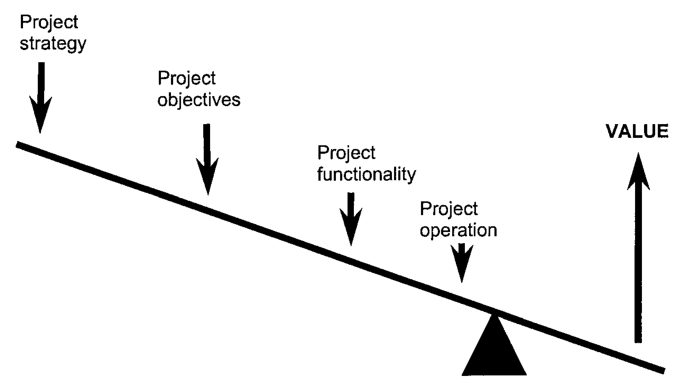
For railroad work: Map these points onto the scope-of-services matrix. A short value and risk session at the concept or alternatives stage, before the boring program and the remedy type are fixed, is where the geotechnical engineer has the most leverage. It is the point to question whether the slide needs a wall or a drainage-and-buttress fix, or whether a culvert should be lined or replaced. Use the time–cost–quality dot to record whether track time or capital cost governs. On emergency slide work it is almost always time. On planned subgrade programs, cost and long-term performance often govern. Record the answer in the scope so that later choices about investigation depth and remedy are judged against the same priorities.
Source: Kelly, J., Male, S. and Graham, D. (2004). Value Management of Construction Projects. Oxford: Blackwell Science, pp. 102–109, 173, 299–302, 307. Summarized and paraphrased; figures reproduced for internal reference. Full reference under Supplemental References.
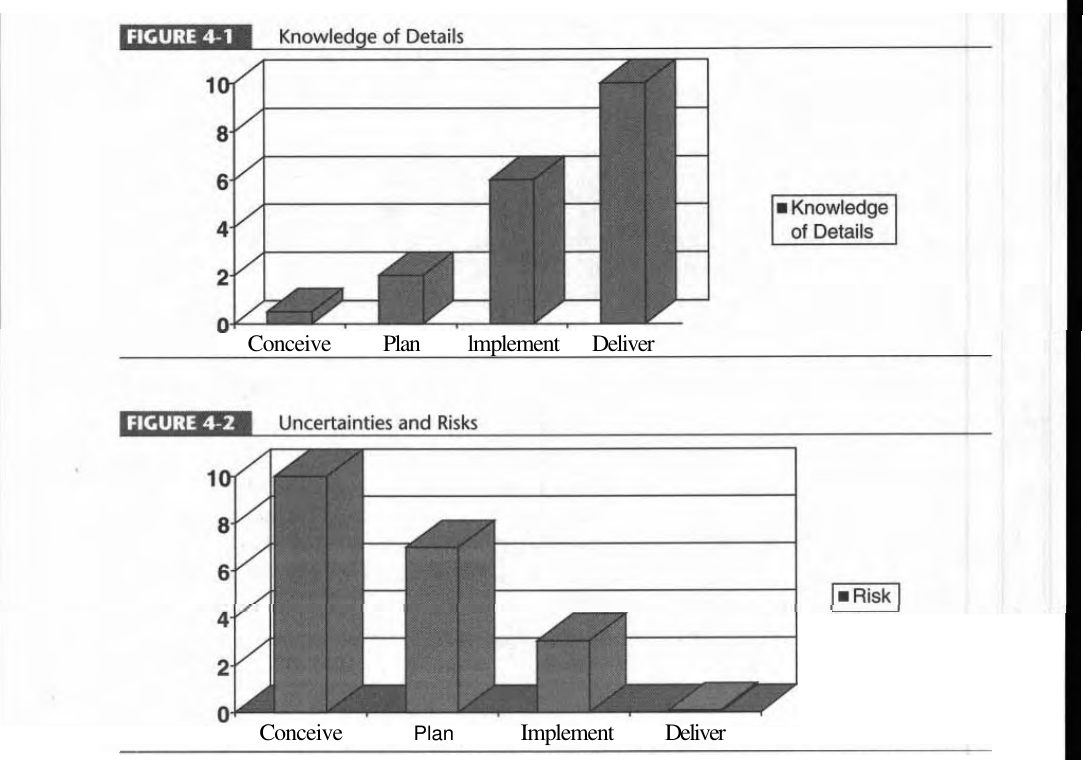
Rad treats an estimate as a forecast whose accuracy depends on how much is known about the project. Late in a project, with full information, estimates are seldom better than about ±3–4%. At inception, with little project-specific data, an order-of-magnitude estimate may end anywhere from about 30% to 330% of final cost. He cites professional-society guidance that the first formal published estimate should be within −40%/+100%. On that basis, a $100 estimate implies a final cost between $60 and $200.
The cheapest point to change a project comes early, while uncertainty is still high. Estimates refine progressively down the WBS: level 0 first, then level 1, and so on. Each refinement is an enhancement of the original estimate, not a new one, which makes variances easier to explain.
He separates three kinds of money that are often combined:
For early estimates he recommends range estimating. Each element gets optimistic, most-likely and pessimistic values, combined as (O + 4M + P)/6. In his example, values of 5, 8 and 35 give 12, not 8. This shows how a single-point “most likely” figure sits close to the optimistic end when the downside is long. When single-point estimates are rolled up they tend to understate cost, because estimators are optimistic.
For railroad work: The scope-of-services matrix should label each phase’s construction cost opinion with its expected accuracy, so that a desktop-stage figure for a slide repair is not taken as a budget. Carry contingency for geotechnical uncertainty, such as undercut depth, rock, groundwater and slide limits, separately from any railroad-held reserve for scope growth, for example added track miles or a changed alignment. Where data are sparse, give three-point ranges for the dominant quantities. As borings and lab results come in, reduce the contingency and record why it was reduced.
Source: Rad, P. F. (2002). Project Estimating and Cost Management. Vienna, VA: Management Concepts, pp. 43–49, 62–64, 111–112. Summarized and paraphrased; figures reproduced for internal reference. Full reference under Supplemental References.