
↑ Parent Menu⌂ Main Menu
← Chapter 2.5 Clays: Properties, Typical Values and Behavior
GHRM
Railway Ground Hazard Risk Management · 2.0 · The Underworld
Sections · click a car to open it

2.5.8 Expansive Clays

Clay is the soil whose behavior depends most on water and time: it is strong when dry and weak when wet, it consolidates for years under new fill, it swells and shrinks with the seasons, and in cut slopes it slowly loses strength until it slides.
Author: Daniel P. Colwell
2.5.8 Expansive Clays

Clays rich in smectite take up water between their mineral layers and swell; they shrink when they dry. Under track, the seasonal cycle causes heave in wet seasons, shrinkage and longitudinal cracking of the embankment shoulders in dry seasons, and recurring surface and cross-level defects. Damage is greatest where moisture changes unevenly: at the edges of embankments, near trees, at culverts and at transitions between cut and fill.

Table 2.5-9: Expansion Potential from Index Tests (after Chen 1988)
Percent passing No. 200Liquid limitSPT N (blows/ft)Probable expansion (%)Swelling pressure (ksf)Degree of expansion
> 95> 60> 30> 10> 20Very high
60–9540–6020–303–105–20High
30–6030–4010–201–53–5Medium
< 30< 30< 10< 1< 1Low

Probable expansion is the total volume change from air-dry to saturated under 1 ksf. Index classification is a screen only.

S (%) ≈ 2.16 × 10⁻³ PI2.44

Eq. 2.5-11 (Seed, Woodward and Lundgren 1962; compacted soils at optimum moisture under 1 psi surcharge)

Eq. 2.5-11 gives about 3% swell at PI = 20, 9% at PI = 30, 23% at PI = 45 and 47% at PI = 60. It overestimates swell of natural undisturbed clays; use it to rank soils, then measure swell with ASTM D4546 (one-dimensional swell or collapse) under the design overburden.

Heave estimate

ΔH ≈ Σ Cs Hi1 + e0 log σ′swσ′f

Eq. 2.5-12 (oedometer method; σ′sw = swelling pressure, σ′f = final vertical stress, Cs = swell index)
  • Depth of the active zone (seasonal moisture change) is typically 5 to 15 ft in humid climates and can exceed 20 ft in semi-arid regions; heave is computed only within it.
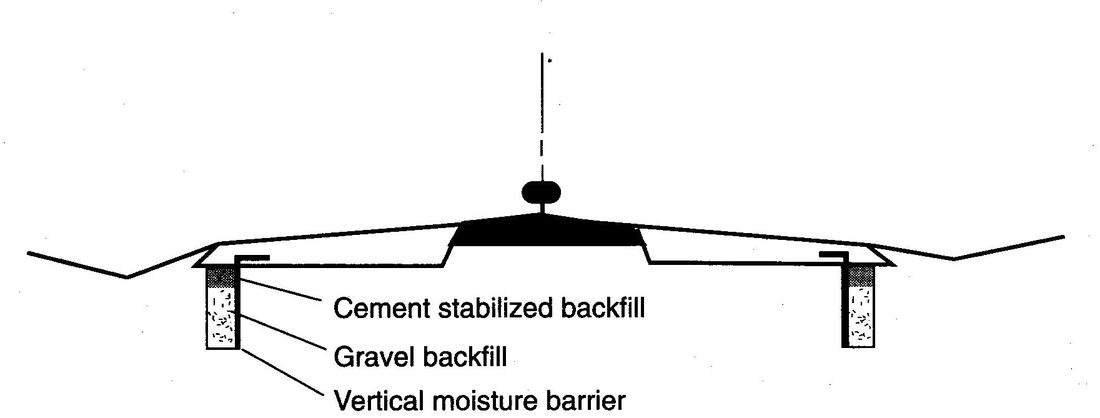
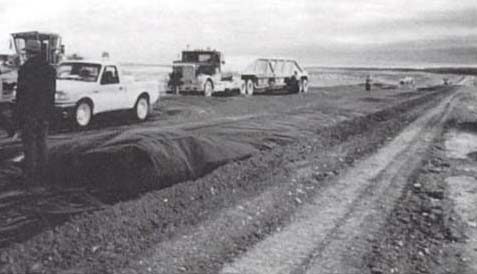
  • Remedies for track: keep water out (sealed ditches, impermeable membranes on the shoulder), keep water constant (vertical moisture barriers), lime stabilization of the subgrade (Chapter 7.2, Section 7.2.7), removal and replacement within the active zone, and removing trees from the toe of embankments.
  • Check sulfate content (ASTM D4327) before lime treatment; sulfates above about 3,000 ppm can form ettringite and cause heave worse than the original clay.
Cross-section diagram of partial encapsulation on Interstate 37 in Texas, showing a pavement section with cement stabilized backfill, gravel backfill, and verti
Photo 2.5.8-1. Cross section of partial encapsulation on Interstate 37 in Texas. Figure courtesy of Wyoming Department of Transportation.Source: FHWA / SHRP2 R02, GeoTechTools.org technology photo sheet.
Black-and-white photograph of a moisture barrier installation along a highway shoulder, with a worker and two pickup trucks alongside a trench lined with geotex
Photo 2.5.8-2. Moisture barrier installation. Wyoming DOT.Source: FHWA / SHRP2 R02, GeoTechTools.org technology photo sheet.
← Previous · 2.0 The Underworld Chapter 2.4 — Silts: Properties, Typical Values and Liquefaction
Next · 2.0 The Underworld → Chapter 2.6 — Peats and Organic Soils: Properties, Typical Values and Behavior