
Geotechnical engineering libraryContact
Slope failures impose direct costs on railroad operations through emergency repair, traffic rerouting, crane mobilization, and environmental spill response. They impose indirect costs through locomotive speed restrictions, customer delivery failures, and regulatory scrutiny. The Federal Railroad Administration does not prescribe slope stability factors of safety directly, but 49 CFR Part 213 mandates that track geometry be maintained within class tolerances — a failed or deforming slope that moves the track out of tolerance triggers an immediate slow order or line closure under FRA authority.
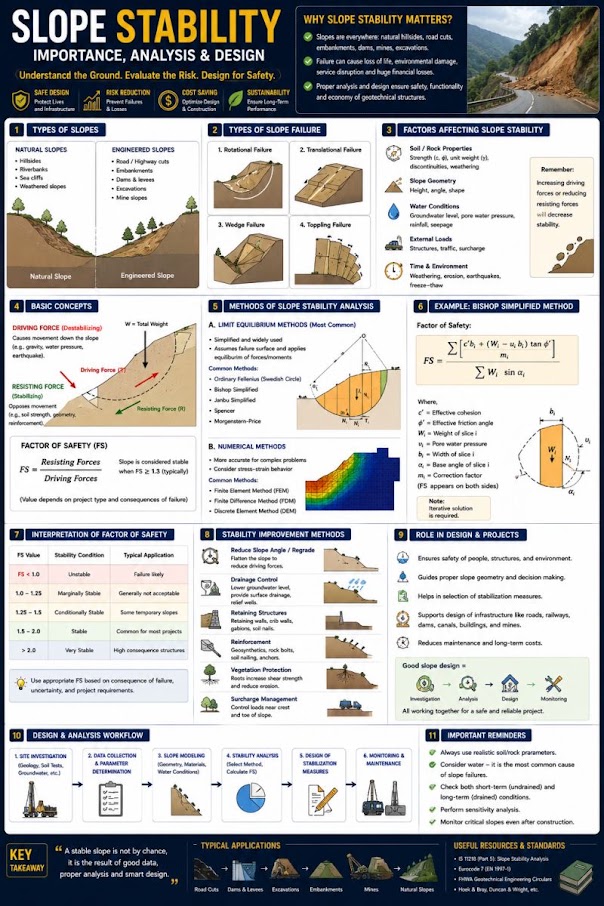
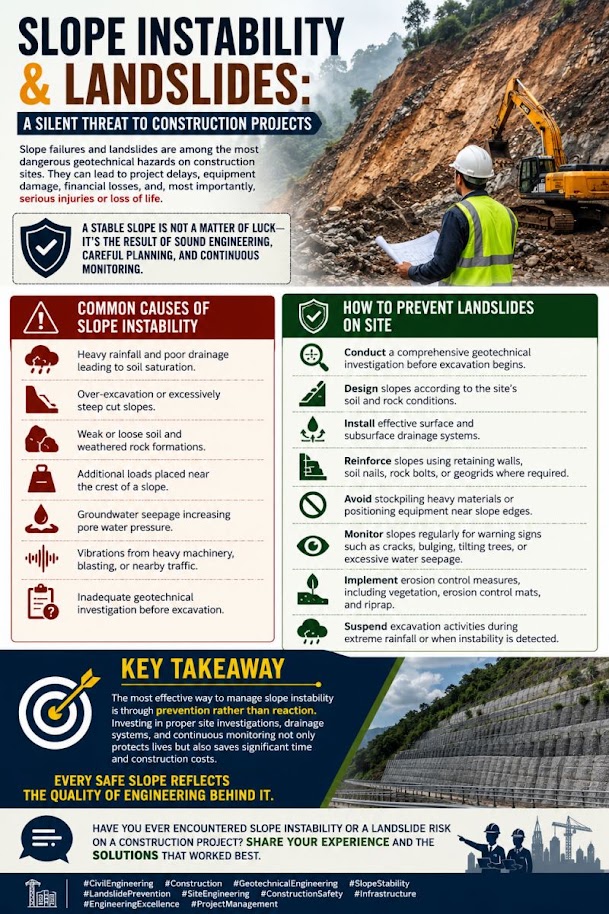
Common practice is FS ≥ 1.5 for long-term static conditions on new embankments (Table 6.3-1). Emergency repair slopes are sometimes accepted temporarily at FS = 1.1–1.2 pending permanent stabilization, with the owner railroad's approval.
| Earthwork | Material | Slope |
|---|---|---|
| Cut | Silt | 2.5–3 : 1 |
| Cut | Muddy (silty) sand | 2–3 : 1 |
| Cut | Gravel | 1.5–2 : 1 |
| Cut | Stable clay | 1–1.5 : 1 |
| Embankment | Usual soils | 1.5–2 : 1 |
| Embankment | Gravel, sand | 2 : 1 |
| Embankment | Erosion-prone soils | 2 : 1 |
Values quoted by Profillidis from Bowles. Starting points only; the factors of safety in this chapter govern.
Profillidis emphasizes studying the geological formation along a cut, especially its joint pattern, so as to disturb the existing equilibrium as little as possible; protecting slopes with vegetation; providing slope drainage to prevent softening; and checking the foundation beneath an embankment as well as the fill. Where the ground slope exceeds 1:10, he recommends benching the embankment base (Chapter 2.1, §2.1.2).
After Profillidis (2014), §9.12; values after Bowles (2001). Full reference under Supplemental References.
Values from these correlations are estimates, not test results. State the equation ID and source when one is used, confirm the soil or rock is within its range, and calibrate against site testing before design.