
Geotechnical engineering libraryContact
Embankments in the Missouri River valley and other river-crossing embankments are subject to rapid drawdown — when a river in flood recedes quickly, the phreatic surface within the embankment lags behind the external water level, creating a destabilizing outward seepage gradient.
The three-stage approach per USACE EM 1110-2-1902 Appendix G:
For free-draining sands and gravels (k of about 10⁻³ cm/s or more, roughly 3 ft/day), drained strengths can be used at the lowered pool because drainage occurs faster than drawdown. For clays (k below about 10⁻⁶ cm/s, roughly 0.003 ft/day), undrained (CU-based) strengths apply throughout.
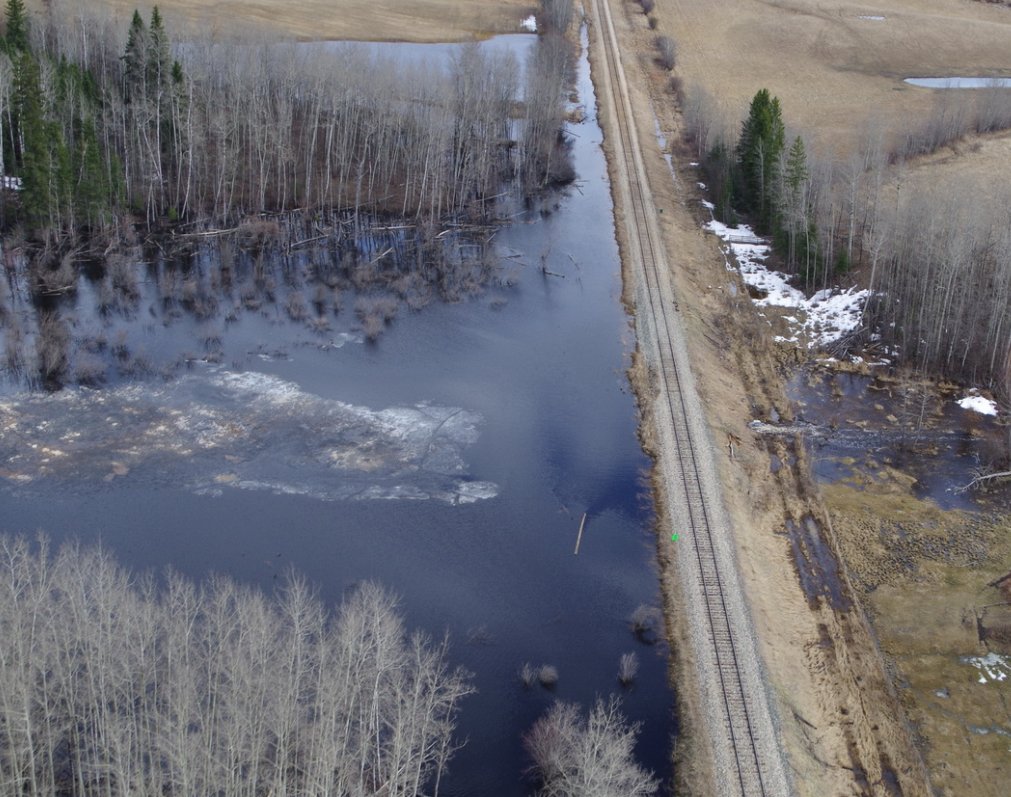
While a pond is high, its weight helps hold the slope despite saturation. When it drops quickly, that support disappears while the fill is still saturated, and seepage reverses outward. Field guidance is that the slope stays at its least stable for about 12 hours after drawdown, recovering over 12–24 hours as the bank drains. Monitor for at least that long, and for at least three days where the drop is 2 ft or more. Beaver-dam or culvert releases create the same condition. The Nakina derailment of 1992, in which two employees were killed, was a rapid-drawdown failure beneath a moving train.
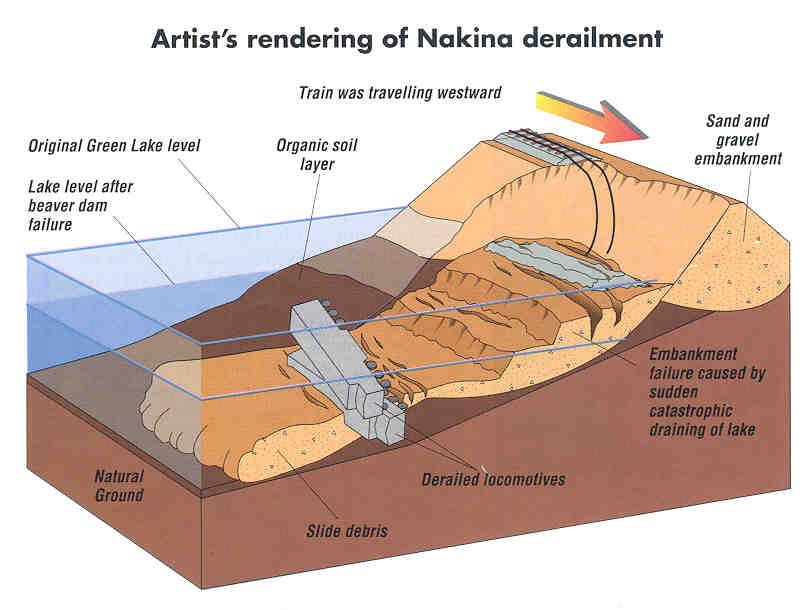
After Geotechnology for Railroaders Program, Module 7.1, Module 4, Module 6.5; Module 7.1 §06; Module 4 §10. Full reference under Supplemental References.
Case study: 6.3.16.1 Flood drawdown failures along the Brisbane River (Look 2023), in §13.16 Case Studies.