
Geotechnical engineering libraryContact
Field case studies by Burt G. Look, from Earthworks: Theory to Practice – Design and Construction (CRC Press/Balkema, 2023), chosen for this chapter’s topics. Each is summarized from the book with its key figures and a closing note on railroad application added by the authors of this manual. Credit for the case material belongs to Look; see item S8 under Supplemental References.
Related section: 6.2.3 Immediate (Elastic) Settlement
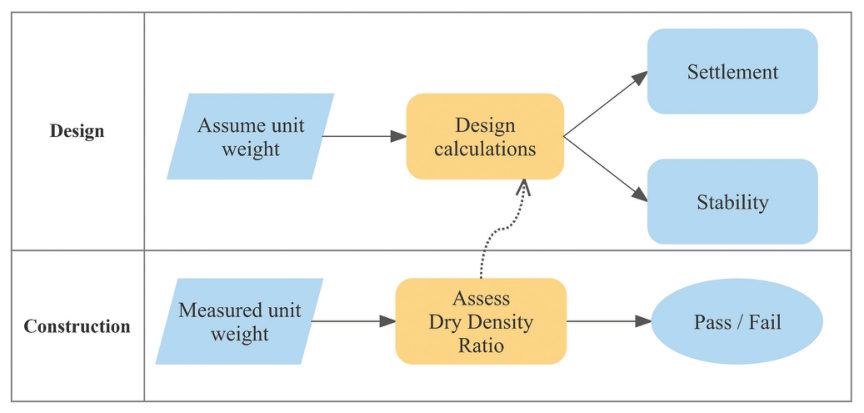
Look found that 127 pcf is used in about 70% of reports for fill unit weight. Compaction records give a large, cheap dataset to check it, and they are rarely used for that. On a Southeast Queensland project, 5,644 density tests had a 10% lower bound of 126 pcf, a median of 134 pcf and a 10% upper bound of 140 pcf. On a North Queensland road, imported fill mostly fell between 135 and 148 pcf, median 141.
On that second job the heavier fill caused more elastic settlement of a high embankment on competent ground than the bill of quantities had allowed for, and a contractual claim followed. Using the as-built 146 pcf instead of 127 pcf gives about 15% more fill settlement. Look’s suggested unit weights for well-compacted fill:
For railroad work: rail embankments are often high and wide, so a 15% settlement difference becomes a real quantity of fill to pay for. Feed the density test results back into the settlement and stability checks.
Source: Look, B. G. (2023). Earthworks: Theory to Practice – Design and Construction. CRC Press/Balkema. Case study §8.8, pp. 266–268. Summarized and paraphrased; figures reproduced for internal reference. Full reference under Supplemental References.