
Geotechnical engineering libraryContact
Field case studies by Burt G. Look, from Earthworks: Theory to Practice – Design and Construction (CRC Press/Balkema, 2023), chosen for this chapter’s topics. Each is summarized from the book with its key figures and a closing note on railroad application added by the authors of this manual. Credit for the case material belongs to Look; see item S12 under Supplemental References.
Related section: 4.1.2 Drilling Method Selection
During construction a project manager ordered extra probe holes and concluded that a different, softer material had been found. It had not. The probes were drilled with a tungsten-carbide (TC) bit auger, while the design borings had been cored. Low- to medium-strength basalt with natural fractures at roughly 4 in spacing was crushed by the heavy rig, and the cuttings came up as “soil” graded through the No. 8, No. 30 and No. 40 sieves. Side by side with the adjacent core, the probe hole produced a new “soil” stratigraphy that conflicted with the design rock profile.
Look notes two related habits. Highly weathered rock is often described as soil in any case, and the material just above the start of coring is usually logged conservatively as a weaker grade because the SPT or wash sample there is less informative than core. Visual strength classification, point load index and other rock testing should be done on the core.
For railroad work: when probe holes, auger refusals or contractor holes are used to check rock levels for cuts, culvert footings or pile toes, record the drilling method on every log and compare like with like. A change of drilling technique is not a change of material.
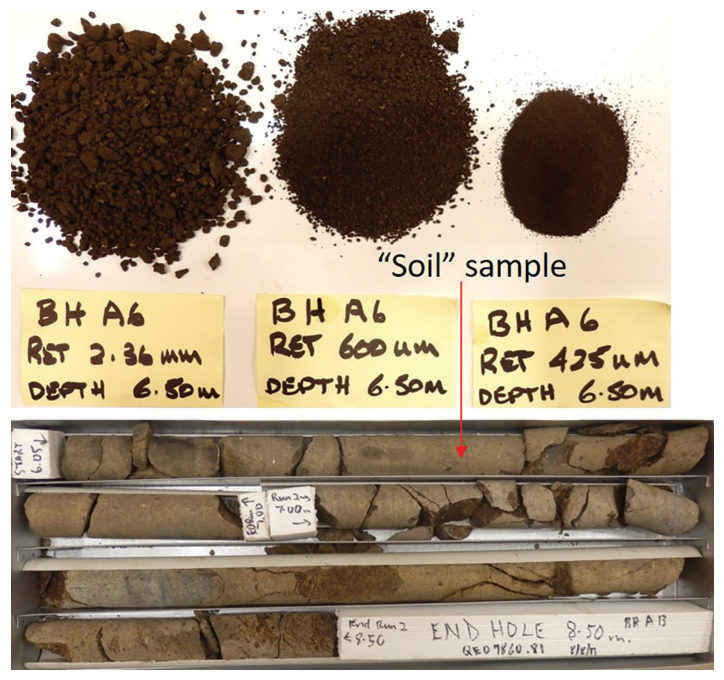
Source: Look, B. G. (2023). Earthworks: Theory to Practice – Design and Construction. CRC Press/Balkema. Case study §2.6, pp. 68–70. Summarized and paraphrased; figures reproduced for internal reference. Full reference under Supplemental References.
Values from these correlations are estimates, not test results. State the equation ID and source when one is used, confirm the soil or rock is within its range, and calibrate against site testing before design.
Related section: 4.1.3 Standard Penetration Test (SPT) — Procedure and Corrections
An SPT N-value is reported as “factual”, but only whole blows can be counted, and the 6 in increments are judged against a chalk mark 0.2–0.39 in. wide in the under-7-second window between blows. That reading error alone is 7%–13% per increment. Digitally measured increments with a 6 in. target averaged 5.8 in. with a standard deviation of 0.63 in. (range 4.3–7.5 in.), a coefficient of variation of 11%–15%. The two test increments partly compensate; the error carried over from the seating drive matters more.
On a large investigation with three rigs, hammer energy and rod length were measured on Rigs 1 and 2. Rig 1 needed a correction factor of about 1.5, so its design strength and modulus rose by 50%. Rig 2 needed almost none. Rig 3 was never measured and was assumed to be 1.0. Across the 1,120 tests, 18% of N-values below 50 changed density class once corrected.
Look’s recommendation is that every rig carry a current energy certificate, as a laboratory carries accreditation, so the cost is shared across projects and firms that measure energy are not undercut by those that do not.
Table 6-LK1. Change in density class after energy correction, 1,120 SPTs at one site (after Look 2023, Table 3.1.19)
| Density class | Original N | Energy-corrected N60 | % changed |
|---|---|---|---|
| Very loose (< 4) | 45 | 43 | 4% |
| Loose (< 10) | 179 | 162 | 11% |
| Medium dense (< 30) | 446 | 354 | 25% |
| Dense (< 50) | 77 | 174 | 18% |
| Very dense (≥ 50), excl. rock | 50 | 64 | n/a |
For railroad work: ask for the hammer energy ratio with every boring subcontract and record the rig on each log. Liquefaction screening, pile capacity and bearing checks on railroad bridges all use corrected N60; an uncorrected value from an unmeasured rig is not a design value.
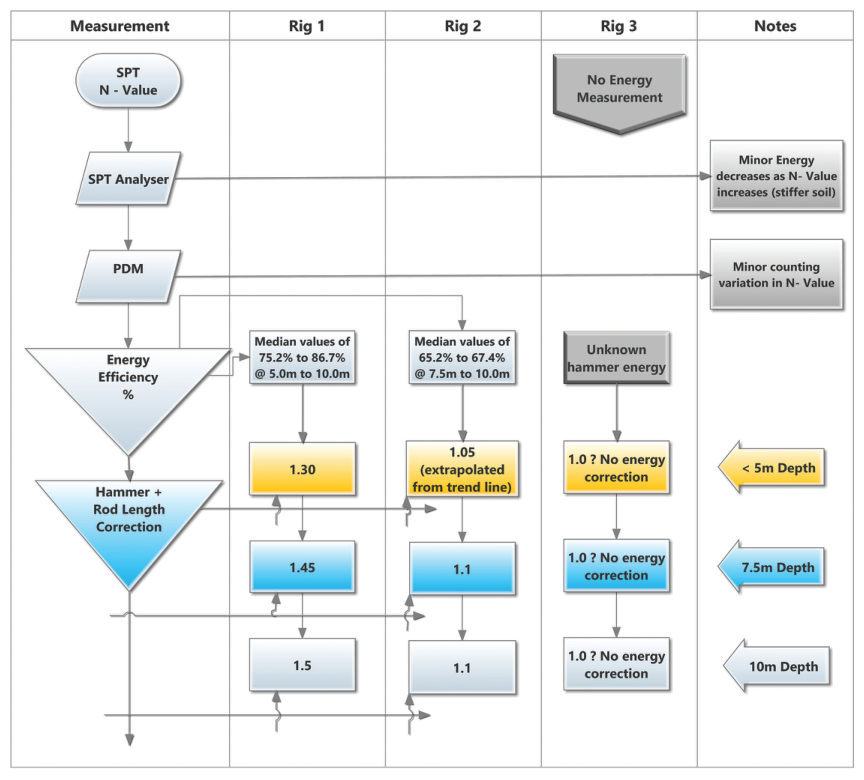
Source: Look, B. G. (2023). Earthworks: Theory to Practice – Design and Construction. CRC Press/Balkema. Case study §6.12, pp. 194–196. Summarized and paraphrased; figures reproduced for internal reference. Full reference under Supplemental References.