
Geotechnical engineering libraryContact
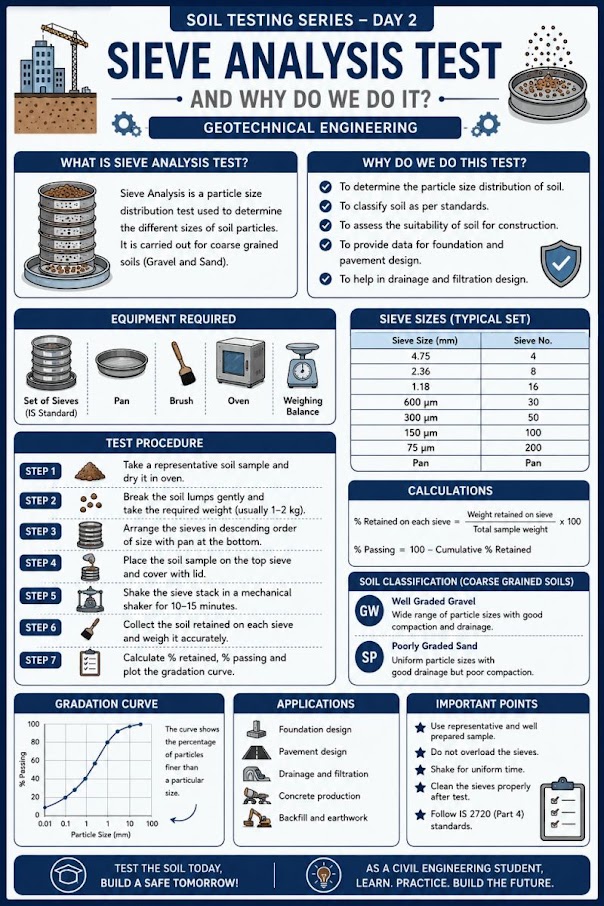
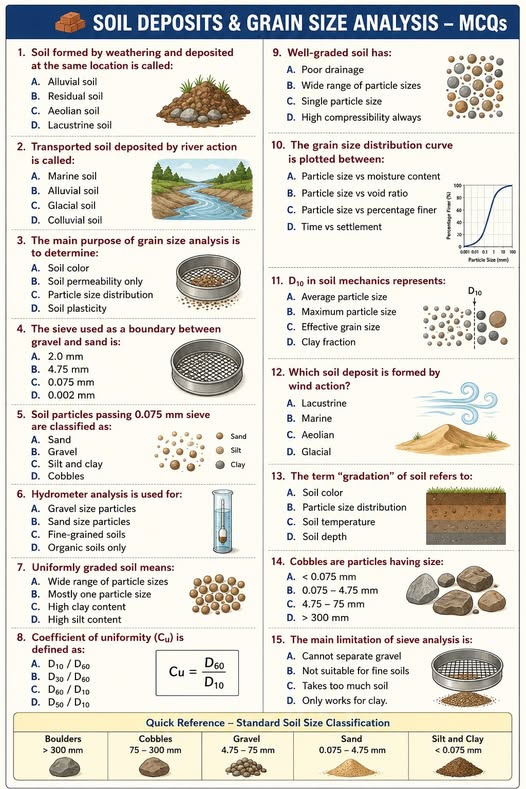
Sieve analysis separates soil particles by mechanical sieving through a standardized stack of sieves. Key sieves and particle size boundaries:
| Sieve | Opening (in.) | Particle Class Boundary |
|---|---|---|
| 3 in. | 3.00 | Coarse gravel / cobble |
| ¾ in. | 0.75 | Fine gravel / coarse gravel |
| No. 4 | 0.187 | Gravel / sand boundary |
| No. 10 | 0.079 | Coarse / medium sand |
| No. 40 | 0.0165 | Medium / fine sand |
| No. 200 | 0.0029 | Sand / fines boundary |
P_i (%) = [Mass passing sieve i / Total dry mass of specimen] × 100
| Symbol | What it is | Comes from | How to get it | Typical range |
|---|---|---|---|---|
| Pi (%) | [Mass passing sieve i / Total dry mass of specimen] × 100 | Lab test | Grain-size curve: sieve (ASTM D6913) plus hydrometer for fines (ASTM D7928). Read D10, D30, D50, D60, D85 from the curve. | by USCS group |
C_u = D_60 / D_10
| Symbol | What it is | Comes from | How to get it | Typical range |
|---|---|---|---|---|
| Cu | D_60 / D_10 | Lab test | Grain-size curve: sieve (ASTM D6913) plus hydrometer for fines (ASTM D7928). Read D10, D30, D50, D60, D85 from the curve. | by USCS group |
C_c = (D_30)² / (D_10 × D_60)
Where D_10, D_30, D_60 = grain diameter (mm or in.) at which 10%, 30%, and 60% of the soil mass is finer, respectively.
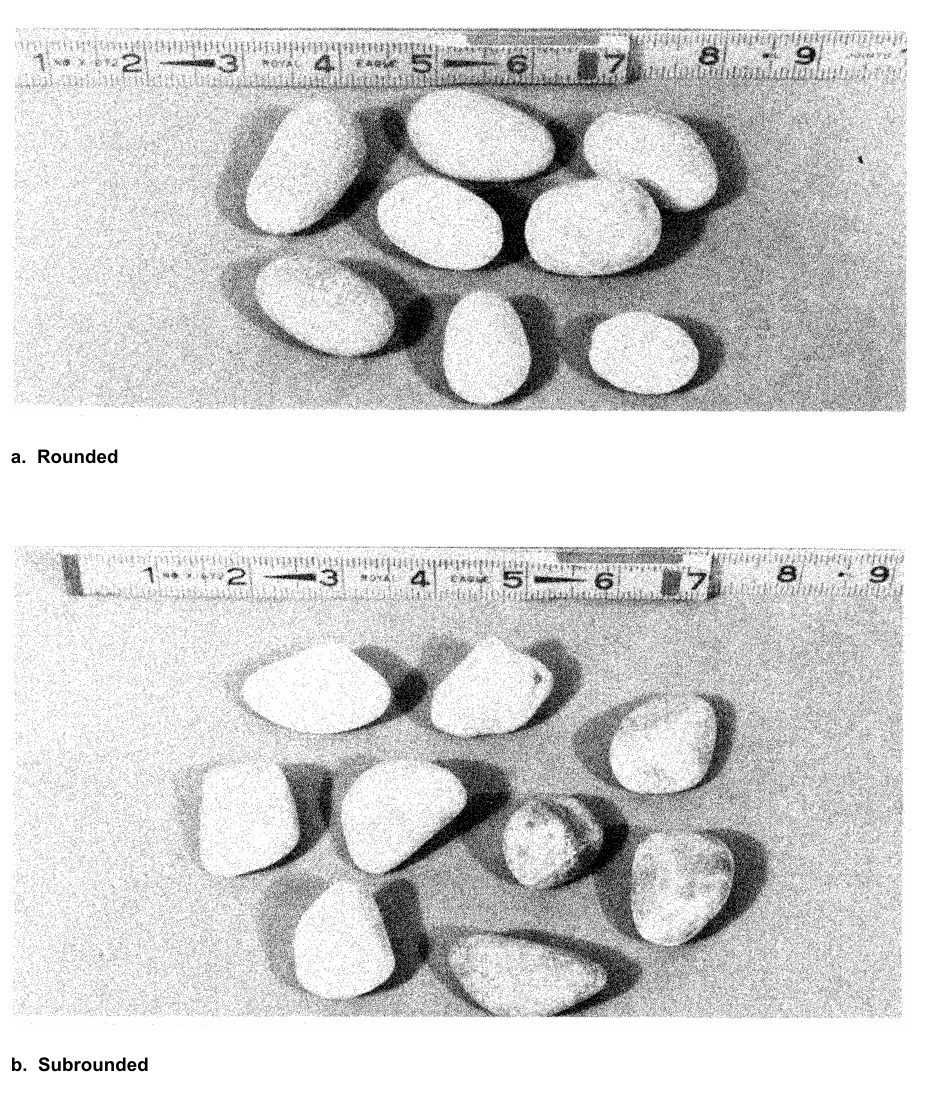
Gravel classification: Well-graded gravel (GW) requires C_u ≥ 4 and 1 ≤ C_c ≤ 3. Poorly graded gravel (GP) fails either criterion. Sand classification: Well-graded sand (SW) requires C_u ≥ 6 and 1 ≤ C_c ≤ 3. Poorly graded sand (SP) fails either criterion.
| Symbol | What it is | Comes from | How to get it | Typical range |
|---|---|---|---|---|
| Cc | (D_30)² / (D_10 × D_60) | Lab test | Grain-size curve: sieve (ASTM D6913) plus hydrometer for fines (ASTM D7928). Read D10, D30, D50, D60, D85 from the curve. | by USCS group |
For the fines fraction (passing No. 200 sieve), hydrometer analysis gives the percent finer than each particle size, including the clay-size fraction finer than 0.002 mm (2 µm). The hydrometer reading at elapsed time t is converted to equivalent particle diameter using Stokes' Law:
D = √(18 × η × L / (G_s − 1) × γ_w × t)
Where:
Note: Hydrometer particle sizes are usually reported in mm. The USCS does not separate silt from clay by size; it uses plasticity (the A-line on the plasticity chart). The 0.002 mm size is the clay-size boundary used by AASHTO and in the activity calculation.
| Symbol | What it is | Comes from | How to get it | Typical range |
|---|---|---|---|---|
| η | viscosity of water at test temperature (g/cm·s) | Constant | Physical constant or standard value. | project-specific |
| L | effective hydrometer depth (cm) | Test setup | Dimension of the test equipment or specimen: from the test standard or the lab/field test record. | project-specific |
| Gs | specific gravity of solids (typically 2.65–2.72 for mineral soils | Lab test | Specific gravity of solids (ASTM D854). 2.65–2.70 is usually adequate for mineral soils when untested. | 2.64–2.80 mineral; lower if organic · by USCS group |
| γw | unit weight of water (g/cm³) = 1.0 | Constant | Physical constant or standard value. | project-specific |
| t | elapsed time (minutes × 60 = seconds) | Time | Elapsed test time (recorded) or the analysis time chosen for design. | project-specific |
Case study: 2.2.14.1 Gradings before and after compaction: the oversize that was never tested (Look 2023), in §8.14 Case Studies.
Case study: 2.2.14.2 Representative sampling from a weathered-rock stockpile (Look 2023), in §8.14 Case Studies.