Railway Ground Hazard Risk Management · 2.0 · The Underworld
Sections · click a car to open it
2.2.1 Background — Why Classification Matters for Railroad Clients
Consistent, reproducible classification of soil and rock is the common language shared between field personnel, laboratory technicians, design engineers, and railroad…
2.2.1 Background — Why Classification Matters for Railroad Clients
Railroad embankment fills, subgrade soils, and foundation materials are evaluated using classification results at every project phase. Specifically:
Classify all boring samples by USCS. Fill placed within 3 ft of the top of subgrade should be non-plastic or of low plasticity to limit swelling and differential track settlement; confirm the owner railroad's limit.
AASHTO M 145 classification is commonly used for subgrade evaluation on reconstruction projects; Group A-7-6 soils warrant a ground improvement assessment.
Subgrade soils classified as A-6 or A-7 warrant CBR testing (Chapter 7.3) before design proceeds.
Soil descriptions on boring logs should include the USCS group symbol, group name, color, moisture condition and estimated consistency (ASTM D2488).
In cold regions, supplement USCS classification with a frost susceptibility rating for all subgrade soils.
Use laboratory-verified USCS classifications (not field estimates) for samples used in settlement and stability analyses.
Field USCS classification is adequate for reconnaissance, but final design, particularly for embankments over 10 ft high, should rest on laboratory classification.
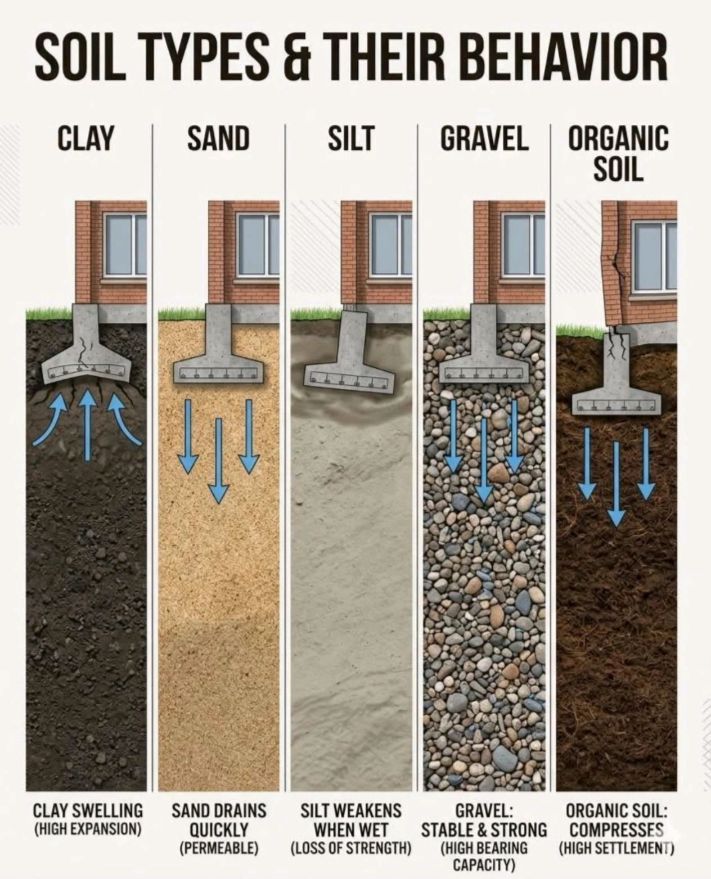
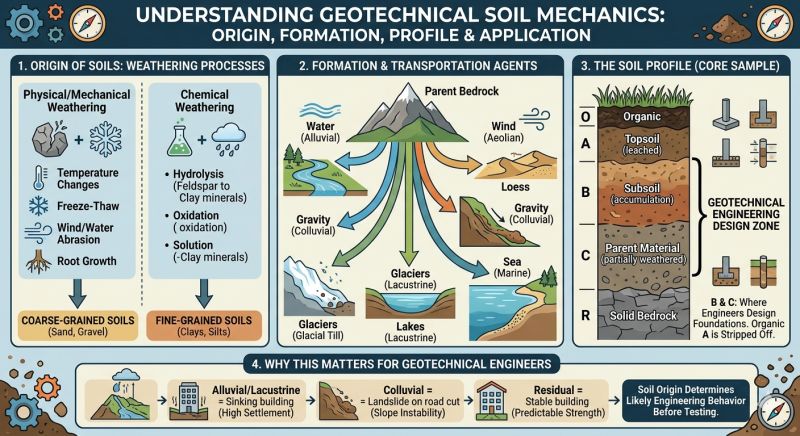
Soil Types and BehavioursSoil Mechanics — Origin, Formation, Profile and ApplicationSoil Mechanics
Classification systems used by railways, side by side
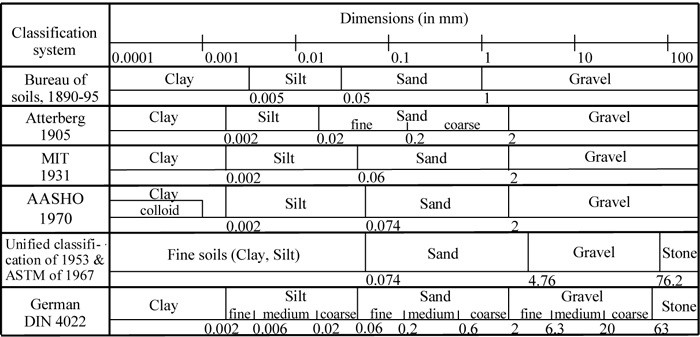
European railways have not used a single system. The United Kingdom, France, Germany, Switzerland and others use the Unified Soil Classification System (Casagrande); Scandinavian railways rely mainly on grain size; Italy, Greece and others use the AASHO (now AASHTO) system. Profillidis calls the USCS the most generally applicable. ASTM D2487 is based on it but requires laboratory classification tests and subdivides further, whereas USCS allows a tentative visual classification. BS 5930 also derives from Casagrande but draws the sand and gravel boundaries differently, and DIN 4022 subdivides silt, sand and clay into fine, medium and coarse.
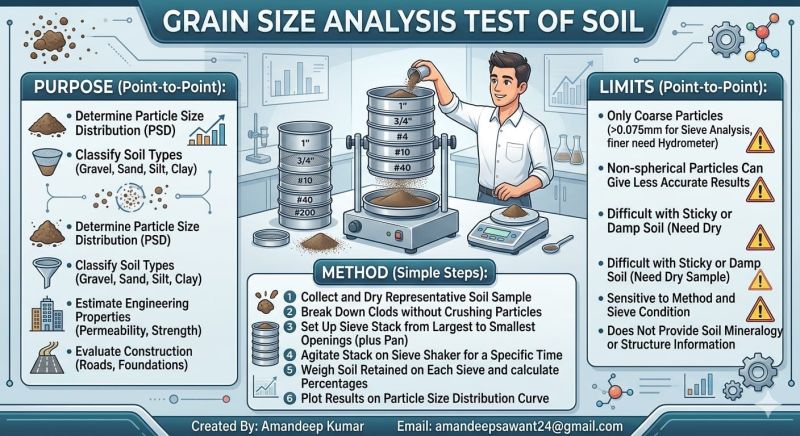
Grain Size Analysis of SoilGrain Size Analysis Test of Soil
Figure 2.2-10 compares the grain-size boundaries of the main systems. They do not coincide (the silt–sand boundary, for example, falls between 0.02 mm and 0.074 mm), so check which system a historic log used before carrying its descriptions into a UIC or AREMA subgrade assessment.
Figure 2.2-10. Grain-size boundaries for clay, silt, sand and gravel in the Bureau of Soils, Atterberg, MIT, AASHO, Unified/ASTM and DIN 4022 systems. Profillidis Fig. 9.2.
Agricultural soil classification: the NRCS soil survey uses Soil Taxonomy and USDA texture classes, which do not convert directly to USCS. How to read them and the most likely USCS group for each texture class are in Chapter 3.2, Section 3.2.10.