
Geotechnical engineering libraryContact
Formerly Geo Rail Chapter 5.3 — Geotechnical Report Preparation
Each boring log must contain (minimum fields per the owner railroad's standards):
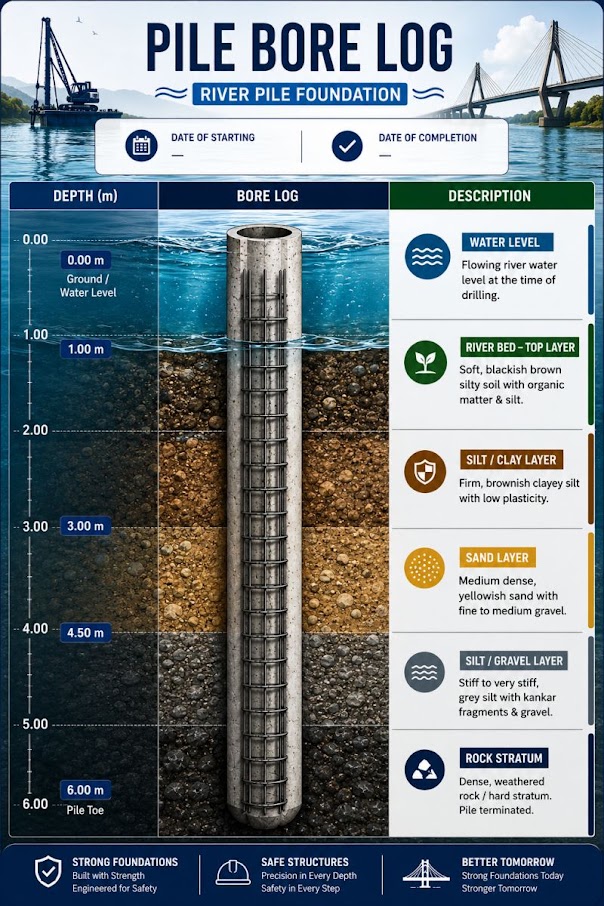
Header Block:
Column Layout (left to right):
| Column | Content |
|---|---|
| Depth (ft) | Depth scale, major depth marks every 5 ft |
| Graphic Log | USCS symbol pattern for each stratum |
| Recovery | Core recovery or SPT recovery (%) |
| SPT N-value | Raw N and N₆₀ ((N₁)₆₀ in the calculation appendix, Section 8.4.4.3) |
| Sample ID | Sample type (SS, ST, RC) and ID |
| Water Content (%) | Field moisture at sample depth |
| Description | USCS classification, color, consistency, structure |
| Remarks | Lab tests assigned, anomalies, notes |
Footer Block:
Values from these correlations are estimates, not test results. State the equation ID and source when one is used, confirm the soil or rock is within its range, and calibrate against site testing before design.
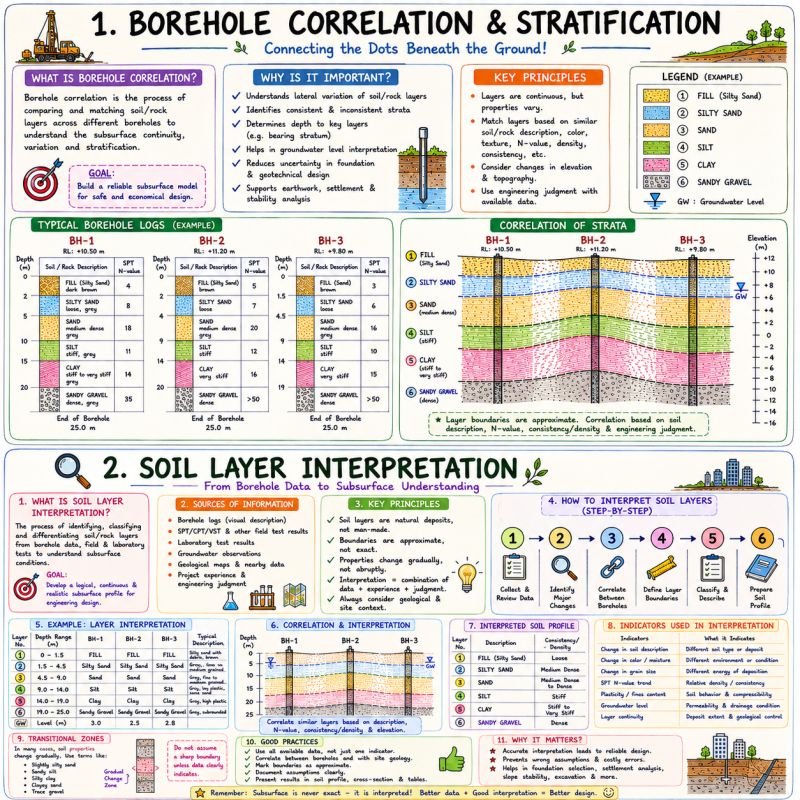
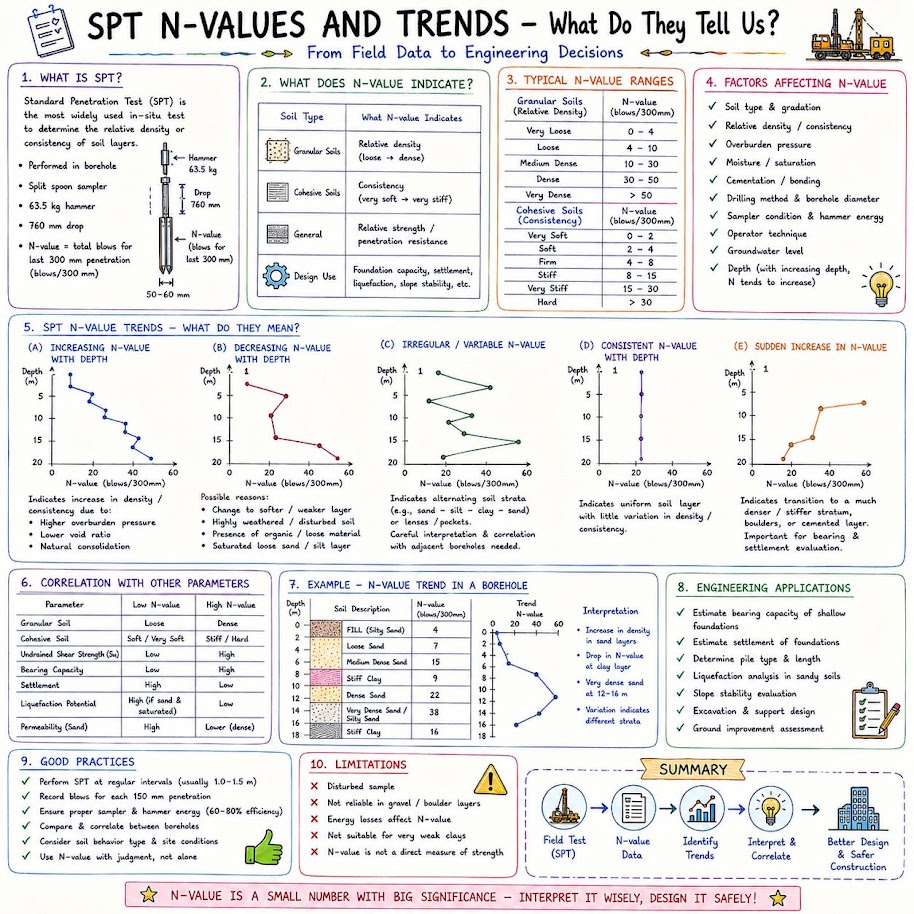
Use the USCS group symbols (ASTM D2487/D2488) with one consistent set of graphic patterns, defined in the legend; ASTM does not standardize the graphic patterns. Client-specific symbol modifications (e.g., the railroad uses a unique "ballast" symbol for borrow verification borings) must be noted in the legend.
Plot N₆₀ as a bar chart on the boring log (bar length proportional to N₆₀; 50-blow refusal plotted as solid bar to the column edge with "50/X" notation). Tabulate raw N, E_m (%), C_B, C_R, C_S, N₆₀, C_N, and (N₁)₆₀ in the calculation appendix; show only N and N₆₀ on the boring log face for clarity.
Levy (2007) notes that a large share of construction disputes arise during sitework, when excavation exposes ground that does not match what the geotechnical report led bidders to expect. A boring describes the strata only at its own location, and a hole drilled a few yards away can show something quite different. Standard report disclaimers say so, and often add that the owner should carry an allowance for foundation costs that cannot be known until construction. Levy points out that this cuts both ways: the disclaimer concedes that actual conditions will only be revealed by excavation, and the recommended allowance is really a contingency for the owner’s benefit, since the owner commissioned and paid for the report.
To support a differing-conditions claim the contractor must show that (1) the contract documents indicated certain conditions that formed the basis of the bid, (2) its reading of those documents was reasonable, (3) the conditions encountered differed materially, (4) they could not reasonably have been anticipated, and (5) the costs claimed arise solely from the difference. Recoverable delay costs can include direct labor and equipment, weather-shifted work, acceleration, idle rented equipment, extended field office and home-office overhead, and lost productivity. On unit-price public work Levy cites a common yardstick that quantities varying by 20% or more from bid quantities may justify repricing.
Source example. On a two-building campus project with an “unclassified” site, rock was found at about El. 162.8 where boring B-23 showed rock at El. 152, and other areas did not match the logs either. The owner rejected a $288,000 rock claim. By sliding a transparent overlay of the boring location plan over the building footprint, the contractor showed that the geotechnical engineer had plotted every boring about 50 ft west of its true position; shifted 50 ft east, all logs matched the field conditions, and the owner paid. On a second project, unsuitable soil below the footing “payline” was settled by agreeing on a reasonable limit to the depth the contractor “owned” on an unclassified site.
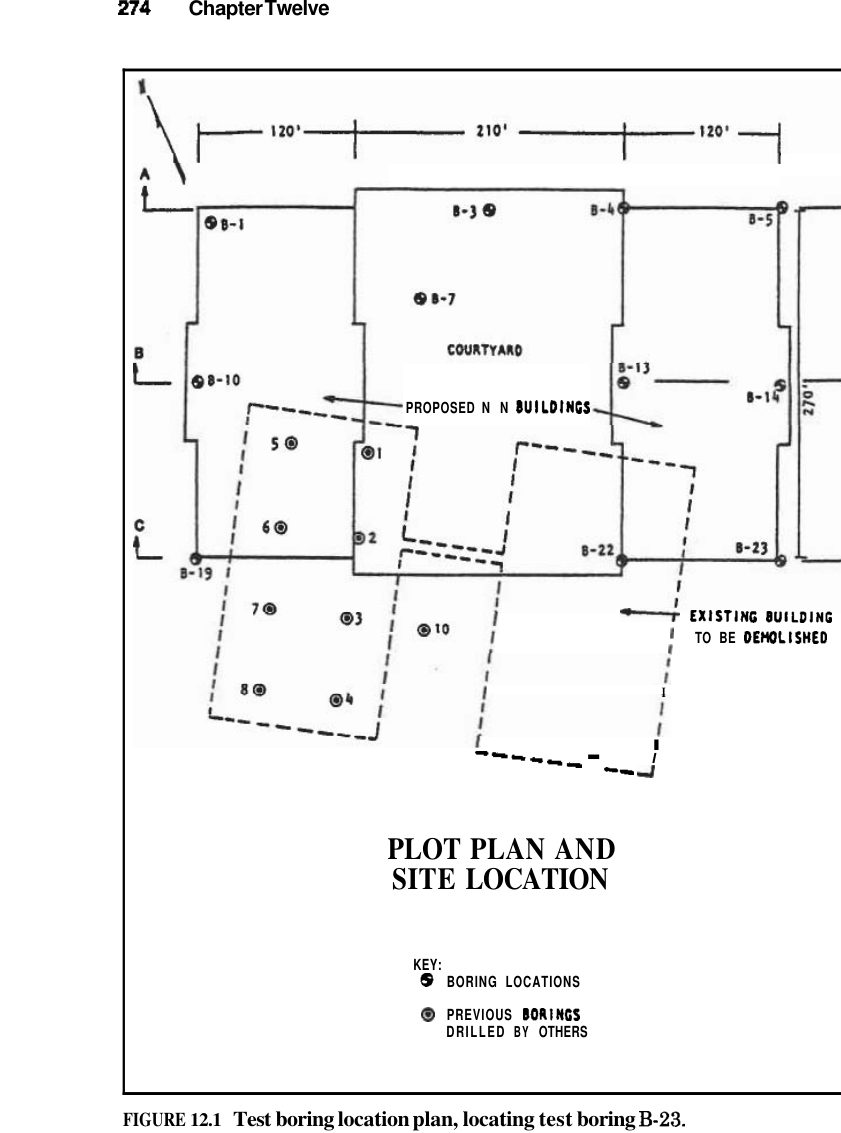
For railroad work: Boring location plans for embankment, culvert and bridge work should be tied to railroad stationing (milepost and track centerline offset) and surveyed coordinates, and checked against the plan sheets before issue; a plotting error is indefensible once a contractor finds it. Log presentation should state the date of water readings and note where conditions between borings are inferred. Keep disclaimer language factual and pair it with clear baseline statements (for example, expected top of rock or depth of soft fouled subgrade) so that the railroad and contractor share one reference for judging whether a condition is truly different.
Source: Levy, S. M. (2007). Project Management in Construction, 5th ed. New York: McGraw-Hill, pp. 271–281. Summarized and paraphrased; figures reproduced for internal reference. Full reference under Supplemental References.