
↑ Parent Menu⌂ Main Menu
← Chapter 8.4 Geotechnical Report Preparation
GHRM
Railway Ground Hazard Risk Management · 8.0 · Reporting
Sections · click a car to open it

8.4.1 Background: Two Fundamental Report Types

Formerly Geo Rail Chapter 5.3 — Geotechnical Report Preparation

The geotechnical report is the primary contract deliverable.
Authors: Daniel P. Colwell and Mario Ruel
8.4.1 Background: Two Fundamental Report Types

Owner railroads recognize — explicitly or implicitly — the distinction between two geotechnical deliverables:

8.4.1.1 Geotechnical Data Report (GDR)

The GDR presents factual subsurface data without interpretation or design recommendations. It is the appropriate deliverable for competitive bid projects where multiple engineering firms will use the same data to develop their own designs, and for early-phase investigations where design parameters have not yet been finalized.

GDR Contents:

  • Project description and investigation scope
  • Boring location plan
  • Boring logs (factual; no interpretation)
  • Laboratory test data tables
  • Groundwater observations
  • Geophysical data (GPR, MASW) — processed, not interpreted
  • No design recommendations, no geotechnical parameters, no analysis

GDR Users: Contractors preparing bids; design engineers developing conceptual foundations; railroad project development group.

8.4.1.2 Geotechnical Design Report (GDR/FGR)

The GDR/FGR (sometimes called a Final Geotechnical Report or Foundation/Geotechnical Report) presents factual data, interpreted parameters, analysis, and design recommendations. It is the primary deliverable for sole-source design contracts.

GDR/FGR Contents: Everything in the GDR plus:

  • Geologic interpretation
  • Engineering classification and property tables
  • Foundation bearing capacity analysis
  • Settlement analysis
  • Slope stability analysis
  • Seismic hazard and liquefaction assessment
  • Ground improvement design (if applicable)
  • Retaining wall design parameters
  • Construction recommendations
  • Geotechnical Special Provisions (GSP)
  • Calculation appendix
  • PE-sealed signature block
Supplemental reference

Preliminary vs. final reports (FHWA)

FHWA adds a timing dimension to the GDR/FGR distinction. Issue a preliminary geotechnical report whenever early data or evaluation can shape the design — typically on large projects or complex sites where alignment or grade might change because of the geotechnical findings. The final report follows once alignment, grade and geometry are fixed and specific recommendations can be made. Whatever the format, FHWA lists five essentials: (1) all exploration data (profile, logs, lab and in-situ results, groundwater); (2) interpretation and analysis; (3) specific design recommendations; (4) discussion of anticipated problems and their solutions; and (5) recommended geotechnical special provisions. FHWA also notes that the report is used during design, during construction and after completion when resolving claims — one reason to write every statement as if it will be read by someone looking for a basis for a claim.

Source: Federal Highway Administration (2017). What is a Geotechnical Report? Geotechnical Engineering fact page

Supplemental reference

A third type: the emergency site-assessment letter

After a slope failure or washout the railroad needs a decision within a day or two, not a GDR. A 2018 preliminary site assessment for a Class I railroad at a main-line milepost (a Class I railroad subdivision located in West Virginia) illustrates the format. It is a two-page letter plus photographs and a sketch, issued the day after a site visit held two days after the event.
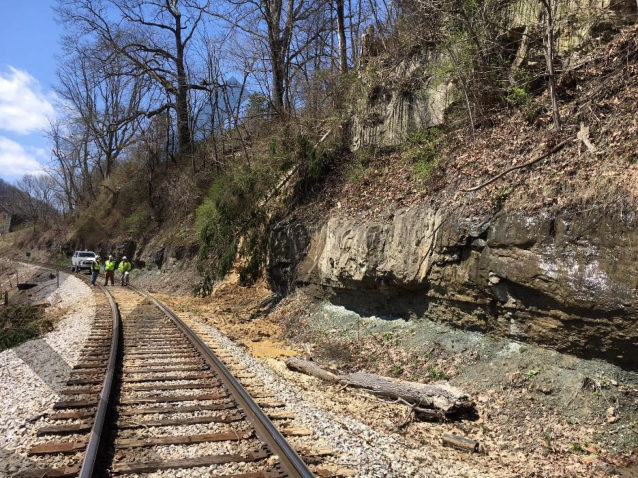
  • Site and problem: 25-mph mainline, 3–5 trains/day, on a side-hill cut about 80 ft above a river. A 70-ft cut slope has a 35-ft rock face at its base. After two weeks of heavy rain and a short intense storm, mud and rock debris slid down a gully from about 80 ft above the track, filled the ditch and covered the track for 50–60 ft. A 10-mph slow order and a night watchman were in place.
  • Observations: a bowl-shaped scarp about 100 ft wide, seeps of about 1–2 gpm, severe tension cracks around the perimeter, and a private driveway above that had cracked and settled about 24 in. (Figures E-S1 and E-S2). Track drainage and a nearby culvert were functioning.
  • Assessment: the remaining material is marginally unstable and will likely come down, with timing driven by rainfall and seepage. It could carry on past the track and take the track structure with it. The right-of-way line was unknown, but most of the source appeared to be off railroad property — a point worth stating explicitly because it affects who can act.
  • Recommendations: keep monitoring, especially during and after rain; keep the ditch and shoulder cleared to maximize catchment; consider removing unstable material mid-slope (access is difficult); remove at-risk trees but leave root systems in place.
Mudslide debris at the toe of the cut, looking east (a main-line milepost on a Class I railroad, April 2018).
Supplemental Figure E-S1. Mudslide debris at the toe of the cut, looking east (a main-line milepost on a Class I railroad, April 2018). Source: A consultant (2018). Preliminary Site Assessment of Slope Instability at a main-line milepost, a Class I railroad subdivision, near Clarksburg, WV (draft letter report, April 6, 2018).

The structure — who/when/why, site and problem, observations, assessment, prioritized interim actions, and photos keyed to a sketch — is a useful template for GDR/FGR programs that begin with an emergency.

Source: A consultant (2018). Preliminary Site Assessment of Slope Instability at a main-line milepost, a Class I railroad subdivision, near Clarksburg, WV (draft letter report, April 6, 2018)
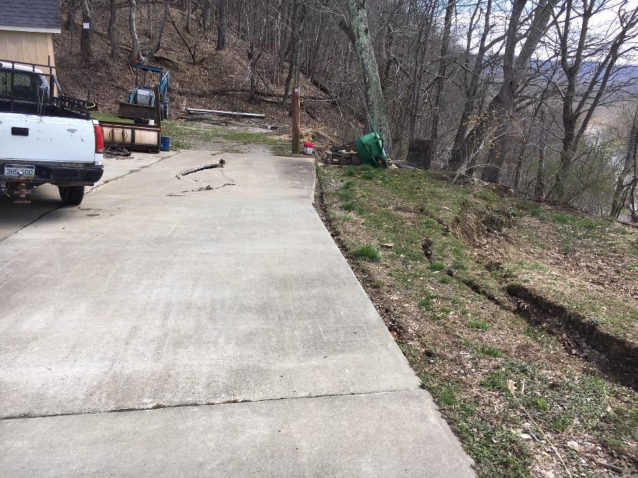
Tension cracks at the head of the slide above the track.
Supplemental Figure E-S2. Tension cracks at the head of the slide above the track. Source: A consultant (2018). Preliminary Site Assessment of Slope Instability at a main-line milepost, a Class I railroad subdivision, near Clarksburg, WV (draft letter report, April 6, 2018).
← Previous · 8.0 Reporting Chapter 8.3 — Memorandums
Next · Appendices → Appendices