
Geotechnical engineering libraryContact
Formerly Geo Rail Chapter 7.2 — Railway Geo-Hazard Risk Management
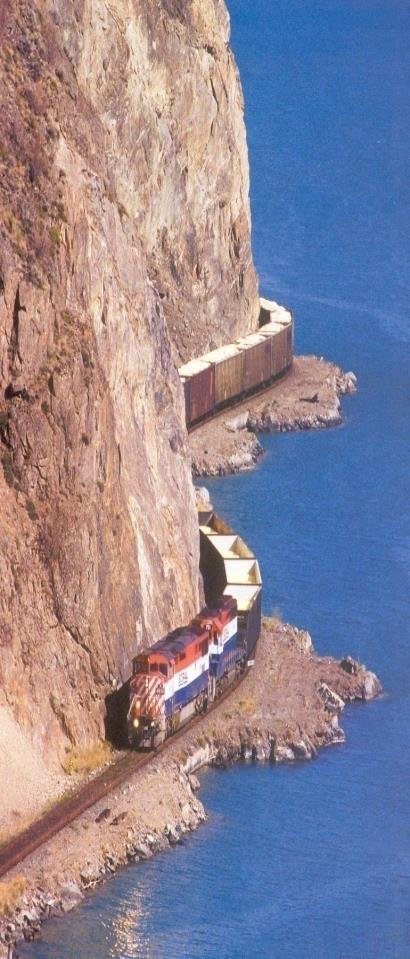
This equation is the working tool for the decision every field engineer eventually faces: can a train safely run over a section of track affected, or potentially affected, by a geo-hazard event? A hazard that would rate as only moderate in isolation can still produce an unacceptable risk if the consequence of failure is severe — for example, a coastal slope where a blocked culvert forces ditch water through an embankment, causing a failure that leaves a near-vertical face and a long drop to open water below, with passenger service running over it. The hazard itself might not be rated severe; the consequence of a failure at that specific location is catastrophic, and the risk decision follows from the product, not either factor alone.
A related concept is the Factor of Safety (FoS): the forces holding a slope or embankment up should be at least 50% greater than the forces working to make it fail (FoS ≥ 1.5). At FoS near 1.0, failure becomes likely once any additional load — such as a heavy train — is added; even where the probability of failure is only moderate, a catastrophic consequence can still make the aggregate risk unacceptable.
The international disaster-risk community breaks the same equation into named components. UNDRR, through its PreventionWeb knowledge platform, describes disaster risk as the likelihood of loss of life, injury, destruction or damage over a given period. That risk arises when a hazard interacts with people and assets that are exposed and vulnerable to it, and it is written Risk = Hazard × Exposure × Vulnerability. The railway term “Consequence & Vulnerability” is the product of the last two: a failure has consequences only where something of value is in its path and cannot withstand it.
| Component | UNDRR meaning | On a railway corridor |
|---|---|---|
| Hazard | A process, phenomenon or human activity that can cause loss of life, injury, property damage, social and economic disruption or environmental degradation. Hazards may be natural, human-induced (anthropogenic) or socio-natural in origin. | The landslide, hydraulic-erosion and subsidence hazards of Section 1.1.3. Many are socio-natural: a cut steepened during construction, a blocked culvert, a beaver dam, or drainage altered beyond the right-of-way. |
| Exposure | The presence of people, infrastructure and other tangible assets in hazard-prone areas. | Track, roadbed, bridges and culverts within reach of the hazard; the trains, crews, passengers and commodities that pass the site; traffic density; and the length of corridor crossing active terrain. Railway exposure is linear and continuous (Section 1.1.1). |
| Vulnerability | Conditions set by physical, social, economic and environmental factors that make an asset or system more susceptible to a hazard’s impact. | Embankment condition and factor of safety, drainage and culvert capacity, ballast fouling, foundation type, line speed, train type (passenger, hazardous materials) and the lack of alternate routes. |
| Capacity | The strengths, attributes and resources available to an organization to manage and reduce risk and strengthen resilience (UNDRR terminology). | Track patrols and inspections, slide-detector fences and instrumentation, weather and GIS alerts, BAHA surveys, the Grade & Slope Stabilization Program, trained staff and emergency response. Capacity lowers vulnerability and shortens how long exposure lasts after an event. |
Three points follow for field practice. First, a hazard on its own is not a loss. The Gaspé-type embankment rates high because of what sits on and below it, not because the slope process is unusual. Second, each measure in the risk control hierarchy (Section 1.1.9) acts on a specific component. Stabilization reduces the hazard. Relocation and protection structures reduce exposure. Drainage repair and strengthening reduce vulnerability. Detection, warning and slow orders build capacity. Third, risk changes over time. Heavier axle loads, more traffic and new passenger service raise exposure. Aging culverts and fouled ballast raise vulnerability. Changing rainfall extremes alter the hazard itself. A site’s rating therefore has to be revisited on a schedule, not filed.
After UNDRR, PreventionWeb, “Understanding disaster risk: Components of risk,” and UNDRR terminology on disaster risk reduction. Full reference under Primary sources.
CAN/CSA-Q850-97, Risk Management: Guidelines for Decision-Makers, frames risk management as an iterative, cyclical process rather than a one-time assessment. Applied to railway ground hazards, the process comprises six stages, with a seventh — Risk Communication — running throughout and feeding information back into the first:
| Stage | Purpose |
|---|---|
| Initiation | Kick off the process for a given hazard, site, or network segment; identify the R.M. team and a responsibility matrix |
| Preliminary Analysis | Identify, categorize, and characterize ground hazards; develop risk scenarios for each category |
| Risk Estimation | Analyze frequency and consequence for each scenario; screen for the greatest loss exposure |
| Risk Evaluation | Weigh the assessed risk against acceptable thresholds using a risk resolution matrix; set mitigation priorities |
| Risk Control | Select and apply proactive mitigation measures, in order of preference: reduce the hazard, protect the track, or warn trains |
| Action / Monitoring | Implement controls; monitor conditions and control effectiveness; feed results back into Preliminary Analysis |
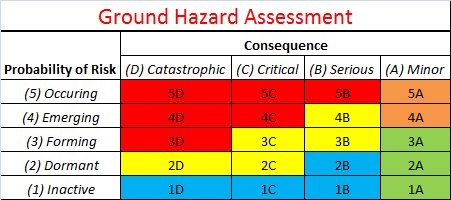
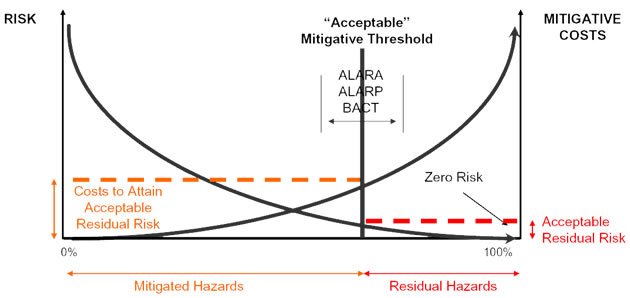
Risk involves three key issues under this framework, and the third is easy to under-weight: the frequency of the loss, the consequence of the loss, and the perception of the loss by the affected stakeholder. Understanding stakeholder perception is treated as being as important as frequency or consequence, because it drives whether operating personnel, regulators, and the public accept a given risk-control decision. “Stakeholder” here means any individual, group, or organization able to affect, or that believes it may be affected by, a decision — for a railroad, primary stakeholders include the operating personnel whose duties bring them into proximity with ground hazards day to day.
In the field the risk equation is a decision tool. It answers whether a train can safely run over track that a geo-hazard has affected, or may affect. The course’s Gaspé example makes the point: a blocked culvert forced ditch water through an embankment above a roughly 100-ft drop to the ocean, on a passenger route. The hazard alone might not have rated severe, but the consequence made the decision obvious. The related factor-of-safety rule of thumb is that the forces holding an embankment up should exceed the driving forces by at least 50% (FoS ≥ 1.5). Where the consequence is catastrophic, even a moderate probability of failure is unacceptable.
After Geotechnology for Railroaders Program, Module 1; §04. Full reference under Supplemental References.