
Geotechnical engineering libraryContact
Formerly Geo Rail Chapter 7.2 — Railway Geo-Hazard Risk Management
Two facts set railway ground-hazard risk apart from ordinary geotechnical practice. First, the alignment itself is a compromise: minimizing gradient and horizontal curvature forces the railroad across significant stretches of geomorphically active ground that a highway or pipeline would simply route around. Second, the exposure is linear and continuous — a single weak link anywhere along tens of thousands of route-miles can stop the entire corridor, and the railroad rarely controls the ground beyond its own right-of-way.
Historically, railway ground-hazard management was reactive: crews responded to washouts, slides, and rockfalls as they occurred. Beginning in the 1980s, the industry moved progressively toward a proactive posture, and by the mid-1990s several Class I railroads had formalized a Natural Hazard Risk Management system (one Class I railroad's dates to 1995; its 1998 “Grade and Slope Stabilization Engineering and Management Protocol” combined previously separate hazard-management practices into one system). The driver was not only safety — though safety is the primary driver — but recognition that geo-hazard incidents, while less frequent than mechanical or track-related service disruptions, carry a disproportionately high average cost per event (see Section 1.1.11).
Soil and terrain conditions across a rail network trace directly to depositional history: understand how the ground was formed, and the likely failure mode follows. Glacial lake deposits and fine-grained ice deposits (silts and clays) dominate in prairie/plains terrain; coarser glacial till reflecting volcanic or sedimentary parent material dominates in shield and mountain terrain; and major river corridors bring their own flood and scour exposure wherever the alignment parallels or crosses them. A regional geotechnical specialist assigned to a defined territory — tracking conditions specific to that area's characteristic hazards (debris flows, retrogressive earthflows, rockfalls, rotational slumps) — is standard practice precisely because hazard character is so terrain- and geology-dependent.
Two concepts recur throughout this chapter and should be stated up front. Zero risk is impossible. Destabilizing forces are always active, conditions are dynamic, and many triggering events are unpredictable — an active warning system and a conservative shutdown decision the night before did not prevent the November 2012 rock shed collapse described in Section 1.1.4. These risks are also not simple “Acts of God” (force majeure — an influence not capable of being controlled, such as an earthquake). Risk can be significantly reduced over time through a proactive R.M. program, applied consistently rather than only after an event. No railroad is luckier than another; every network takes geo-hazard hits. What distinguishes a well-run program is a track record of mitigating impact, limiting losses, and recovering rapidly.
Profillidis observes that railways have tended to spend their improvement effort on the superstructure (rail, ties, ballast, subballast), while many of the problems that show up there are traceable to the subgrade. He also notes that early subgrade practice was borrowed from highway engineering: useful experience, but highway specifications applied literally did not fit the particular loading of a railway.
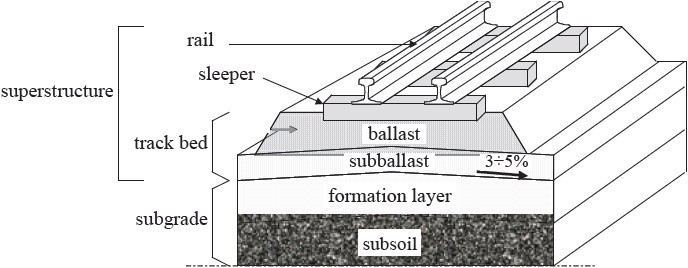
He distinguishes two situations. On a new line, subgrade design follows from axle load, tonnage, tie type and ballast thickness, together with soil type, hydrogeology and strength. On an existing line, the bottom of the subballast and the top of the subgrade have become a compact zone that should be disturbed as little as possible. Interventions should be limited to locations with demonstrated problems and timed with periodic maintenance, and the choice between improving the subgrade and thickening the ballast should rest on a technical and economic comparison.
The subgrade must let trains run safely at line speed, carry the axle loads, and minimize future maintenance cost. It does so by limiting settlement of the foundation and fill, staying mechanically stable under train loads, shedding rain and groundwater quickly, and not deteriorating over its working life.
After Profillidis (2014), §7.2 and §9.1, Fig. 7.1. Full reference under Supplemental References.