Railway Ground Hazard Risk Management · 2.0 · The Underworld
Sections · click a car to open it
2.1.8 Grade Crossings, Turnouts and Special Trackwork
Everything beneath the subgrade surface that the track depends on — embankments, cuts, foundation soils, drainage structures, bridge approaches and the structural foundations that share the right-of-way.
2.1.8 Grade Crossings, Turnouts and Special Trackwork
These locations concentrate dynamic load and trap water, so they fail sooner than open track on the same subgrade.
Grade crossings: The crossing surface and pavement restrict evaporation and cross-drainage.
Water collects beneath the crossing panel, and pumping follows. Provide subsurface drainage through the crossing, and
extend subballast and any geosynthetic separator beyond the crossing limits.
Turnouts and diamonds: Frog and switch impacts produce higher dynamic loads. Longer switch ties
also span a wider zone of subgrade. Investigate subgrade strength and drainage specifically at turnouts, not by assumption
from the adjacent open track.
Yard and industry track: Often built on minimal subballast with poor drainage, and heavily loaded
by switching moves. Pavement-subgrade methods in Chapter 7.3 may apply where tracks are embedded in paved areas.
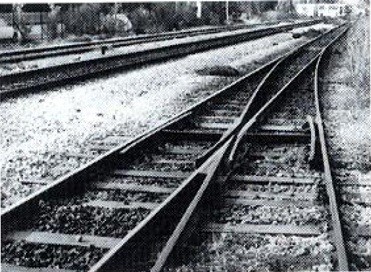
Figure 2.1-9. A simple turnout in service (photo). Profillidis Fig. 15.1.
Turnouts as a foundation element
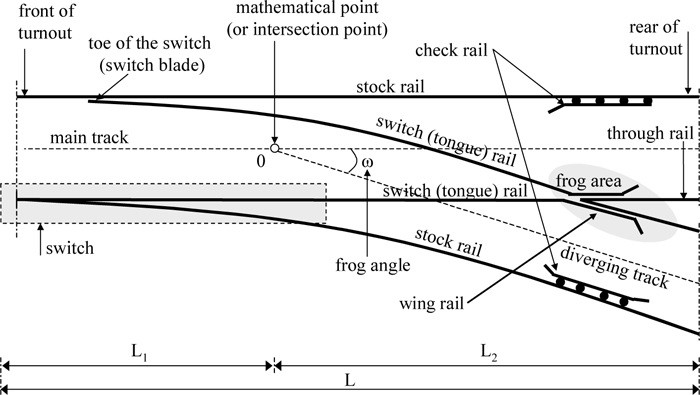
A turnout lets a vehicle pass from the main track to a diverging track without interrupting its movement. Its parts are the stock rails (fixed), the switch or tongue rails (moving), the frog at the intersection point, set at a frog angle stated as a tangent such as 1:9 and usually made of manganese steel, and the check rails opposite the frog. Turnouts must carry the line’s axle load, impose the fewest possible speed restrictions, resist wear and require little maintenance.
Figure 2.1-10. Components of a turnout: stock rails, switch rails, mathematical point, frog angle, frog, check and wing rails. Profillidis Fig. 15.3.
Keep vertical curves at least 16–33 ft clear of the beginning and end of switches and crossings.
Turnouts are levelled with light (portable) tamping equipment, which needs sound, clean ballast. A fouled or poorly drained bed under a turnout cannot be maintained to geometry, so the substructure under special trackwork deserves the same investigation and drainage attention as a bridge approach.
Turnouts on bridges, sharp curves and similar locations may also need locally increased lateral resistance (special tie shapes, roughened seats, transverse anchors).
After Profillidis (2014), §13.6, §14.11.2, §15.1–15.2, §16.8, Figs. 15.1, 15.3. Full reference under Supplemental References.
Asphalt underlayment at crossings, turnouts and bridge approaches
Its main North American use is on short problem sections: diamonds, turnouts, bridge approaches, tunnel floors and highway crossings. There are two forms:
Underlayment replaces the subballast only. The ballast stays above it and can still be tamped.
Full depth replaces both the ballast and the subballast.
Typical underlayment.
A 4–8 in. asphalt mat with 5–10 in. of ballast between the tie bottom and the mat. Thickness depends on axle load, tonnage and subgrade stiffness; see the NAPA–Asphalt Institute Simplified Design Guide for Hot Mix Asphalt (HMA) Railroad Trackbeds for design.
The mix is a dense-graded highway base with slightly more binder and fines, 1–3% air voids and a maximum aggregate size of 1–1½ in.
The ballast cover protects the asphalt from oxidation and temperature extremes.
Full-depth limitations. Full depth reduces lateral and longitudinal resistance and resilience. It cannot be tamped, which is a serious limitation if the subgrade moves. It is also hard to rebuild. Use it only where those losses are acceptable and geometry adjustment is essentially not needed.
Drainage. Asphalt blocks upward drainage from the subgrade. Where seepage is expected, provide a granular drainage layer beneath the mat. That layer also serves as a construction platform.