
Geotechnical engineering libraryContact
The foundation is the natural ground on which the embankment rests. Its behavior controls long-term settlement, deep-seated stability, and the response to new loading such as heavier cars, a second track or a grade raise.
| Foundation Condition | Why It Matters | Key Tests | See |
|---|---|---|---|
| Soft to medium clay | Consolidation settlement; undrained failure under new fill | ASTM D2435 (consolidation), D2166 / D4767 (strength), field vane D2573, CPTu D5778 | Chapters 6.2, 6.3 |
| Organic soil, peat, muskeg | Large primary and secondary compression; "muskeg punching" | ASTM D2974 (organic content), D2435 | Chapters 1.1, 6.2 |
| Sensitive and quick clays | Brittle failure with little warning; retrogressive slides | Field vane (peak and remolded), D4648 laboratory miniature vane | Chapters 1.1, 6.3 |
| Loose saturated sands and silts | Liquefaction and cyclic softening | SPT D1586, CPT D5778, fines content D1140 | Chapter 6.5 |
| Collapsible soils (loess, some alluvium) | Sudden settlement on wetting | ASTM D4546 (collapse potential) | Chapter 3.8 |
| Karst (soluble bedrock) | Sinkholes, raveling voids above bedrock | Geophysics (ASTM D6429 guide), probe borings, rock coring | Chapters 3.8, 5.1 |
| Undermined ground | Mine subsidence (sag and pit) | Mine maps, borings to mine level, monitoring | Chapter 3.8 |
Borings for embankment evaluation should extend through the embankment and at least through the compressible or weak foundation layers into competent material. Use the depth criteria in Chapter 3.9.
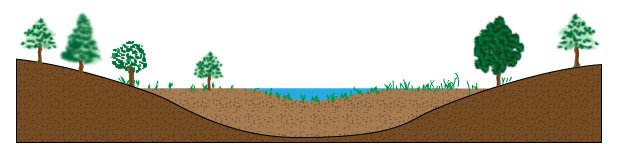
A peat bog forms as vegetation fills a dying lake, and part of it may float on lacustrine soil. Its limited strength comes from intertwined fibers, so ditching or cable plowing that cuts them can turn a quiet section into a problem site. Old track over muskeg often sits on a corduroy mattress of crosswise logs; where it has decayed, peat pumps up through the gaps under traffic. Organic soils can compress by up to about 40%: 12 ft of peat can mean 5 ft of settlement. Excavate thin peat; build over thick peat and let it settle.
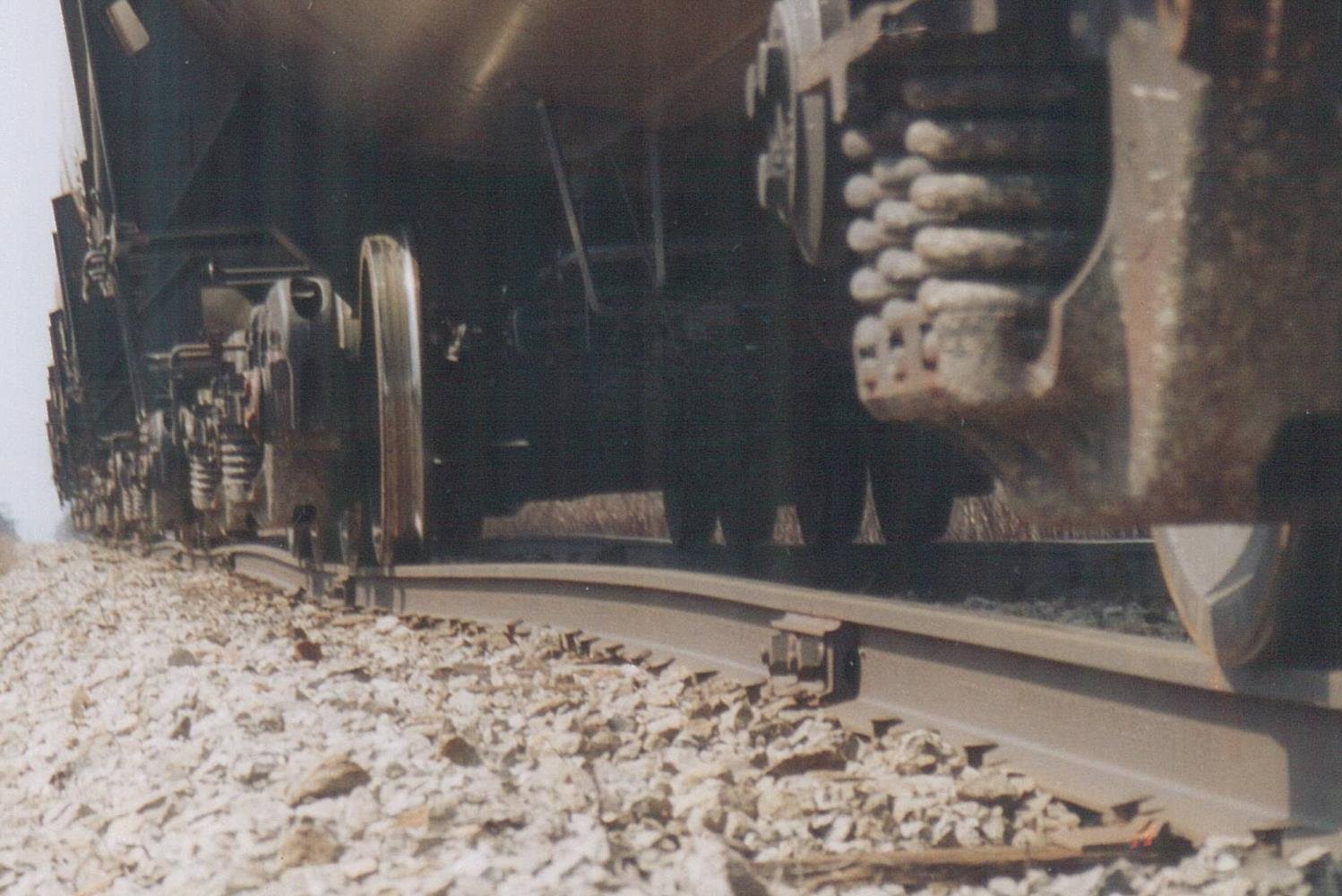
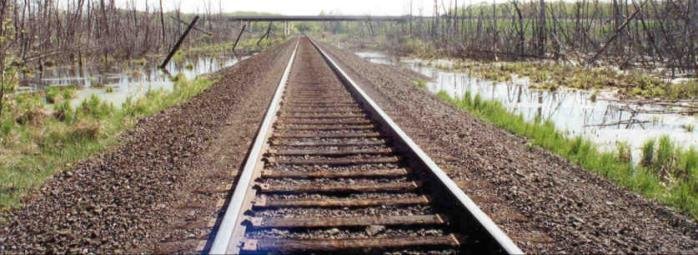
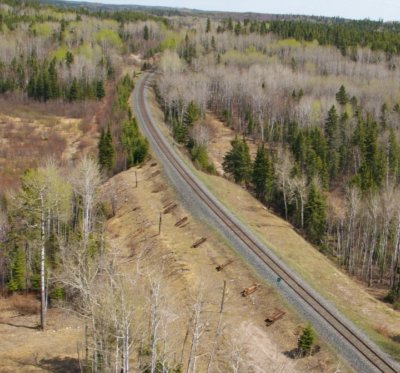
On soft clay or peat, an embankment can fail at its base as soft soil squeezes out from under the load. On peat, a stabilizing berm should be about twice as wide as the peat is deep, built in thin lifts over geogrid or woven geotextile, and never placed after removing the peat crust.
After Geotechnology for Railroaders Program, Module 2, Module 3, Module 5, Module 6.1; Module 2 §07, §08; Module 5 §06; Module 6.1 §03. Full reference under Supplemental References.
Values from these correlations are estimates, not test results. State the equation ID and source when one is used, confirm the soil or rock is within its range, and calibrate against site testing before design.