
Geotechnical engineering libraryContact
For this manual, the track substructure is divided into the track bed (ballast, subballast and the prepared top of subgrade, covered in Chapter 2.3) and the foundation elements beneath and alongside it. The distinction matters because the two groups are maintained, inspected and funded differently.
| Foundation Element | Function for the Track | Governing References | Typical Geotechnical Concern |
|---|---|---|---|
| Embankment (fill) body | Raises the formation to grade; carries track load to the foundation | AREMA MRE Ch. 1 (Roadbed); client earthwork specs | Uncompacted historic fill, ballast pockets, side-slope instability |
| Cut section and cut slopes | Lowers formation to grade through high ground | AREMA MRE Ch. 1 (Roadbed) | Seepage, softening of cut floor, slope raveling, rockfall |
| Foundation soils beneath fills | Supports the embankment and train load | AREMA MRE Ch. 1; Chapters 5.1–5.3 | Soft clay, organics, sensitive or collapsible soils, karst |
| Drainage elements (ditches, underdrains, culverts) | Keep water out of and away from the substructure | AREMA MRE Ch. 1 (Culverts); 49 CFR 213.33 | Blockage, piping along barrels, corrosion, overtopping |
| Bridge approaches and transition zones | Transition between ballasted track and a rigid structure | AREMA MRE Ch. 1 and Ch. 8; 49 CFR Part 237 | Differential settlement ("bump"), stiffness change, backfill loss |
| Structural foundations adjacent to track | Support bridges, walls, retainers, signal and catenary structures | AREMA MRE Ch. 8; client standards | Surcharge from train load, scour, settlement, lateral movement |
| Crossings, turnouts and special trackwork | Carry concentrated and impact loads | AREMA MRE Ch. 1 and Ch. 5; client standards | Poor drainage, pumping, rapid geometry loss |
| Utility and pipeline crossings | Third-party facilities within the substructure | AREMA MRE Ch. 1 (Pipelines); client utility-crossing rules | Settlement or voids from leaks, trench backfill, casing failure |
The consultant's responsibility is to identify which of these elements are present at a site, which one governs performance, and whether its condition is changing. A site that "just needs surfacing" every year is rarely a ballast problem — it is usually one of the elements in this table.
Ballasted track is a flexible support; slab track (concrete slab or asphalt over a ballast-concrete layer and an anti-frost layer) is an inflexible support. Ballasted track remains the norm because it tolerates differential settlement, costs much less to build and gives good lateral resistance even at high speed. Slab track is most effective in tunnels, where it allows a smaller cross-section and reduces maintenance, but it is noisier.
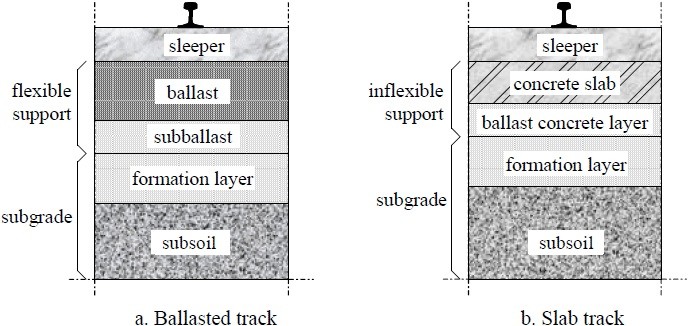
The choice turns on construction cost (much higher for slab), maintenance cost (much higher for ballast) and the technical needs of the site. German figures from 2008 put slab track at €175–207 per foot against €111 per foot for ballasted track, before the extra earthwork and subgrade work that slab track needs. Slab-track maintenance was reported at about 10% (Germany) to 20–30% (Japan) of the ballasted-track figure. For a slab the subgrade must be essentially settlement-free, which moves the geotechnical risk from maintenance into design and construction.
After Profillidis (2014), §7.3, §17.8, Fig. 7.4. Full reference under Supplemental References.