↑ Parent Menu⌂ Main Menu
← Chapter 6.4 Infiltration and Seepage
GHRM
Railway Ground Hazard Risk Management · 6.0 · Analysis
Sections · open a dropdown to go to a section or subsection

6.4.4 Internal Erosion and Piping

How rainfall and water move into and through railroad fills, slopes and subgrade, how that is measured, and what it does to stability.
Author: Daniel P. Colwell
6.4.4 Internal Erosion and Piping

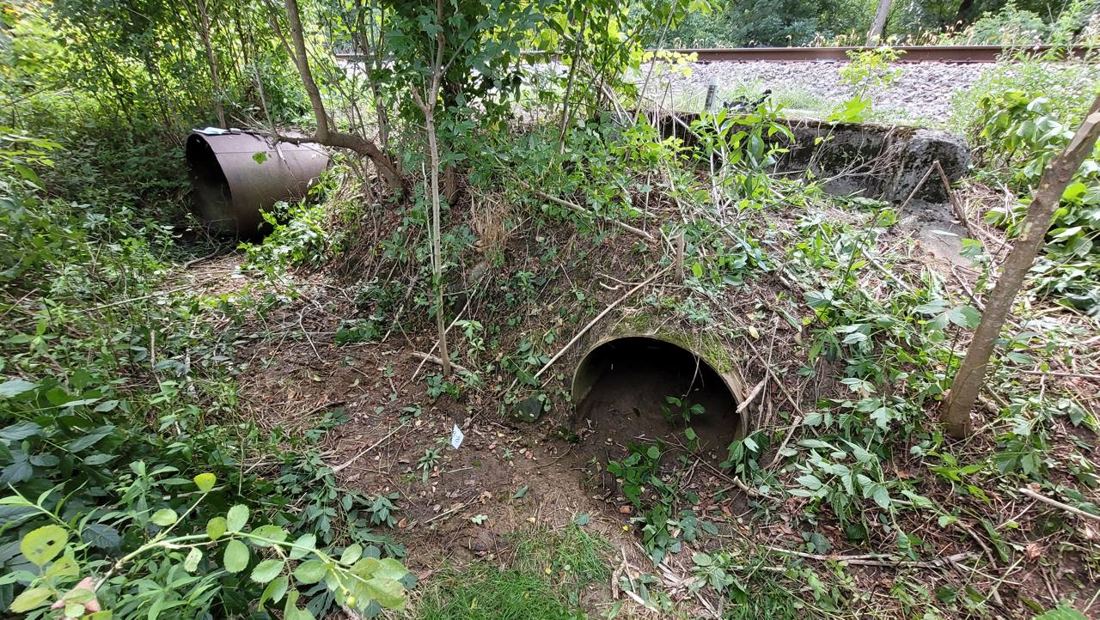
When the upward exit gradient at the toe approaches the critical gradient, the effective stress in the soil goes to zero and particles can be carried out. Once a pipe starts it concentrates flow and grows backward toward the water. Culvert joints that have separated, animal burrows and old timber structures in a fill give water the same short cut.

Equation 6.4-4. Critical hydraulic gradient

ic = γ′ / γw ≈ 1.0 for most soils;  factor of safety = ic / iexit, commonly at least 3 for heave and piping
Table 6.4-2. Filter criteria (Terzaghi type) for drains and toe filters
RequirementCriterionPurpose
RetentionD15 filter / D85 soil ≤ 4 to 5Keep soil particles from passing through the filter
PermeabilityD15 filter / D15 soil ≥ 4 to 5Filter much more permeable than the soil
Uniformity and segregationWell-graded filter, placed without segregationConsistent performance
GeotextilesApparent opening size and permittivity chosen for the soilWhere granular filters are impractical
Culvert outlets at the toe of a fill, one pipe section separated. Separated joints let water and fines move through the embankment and are a common start of piping in railroad fills.
Figure 6.4-4. Culvert outlets at the toe of a fill, one pipe section separated. Separated joints let water and fines move through the embankment and are a common start of piping in railroad fills.
← Previous · 6.0 Analysis Chapter 6.3 — Slope Stability Analysis
Next · 6.0 Analysis → Chapter 6.5 — Seismic Hazard and Liquefaction