Geotechnical engineering libraryContact
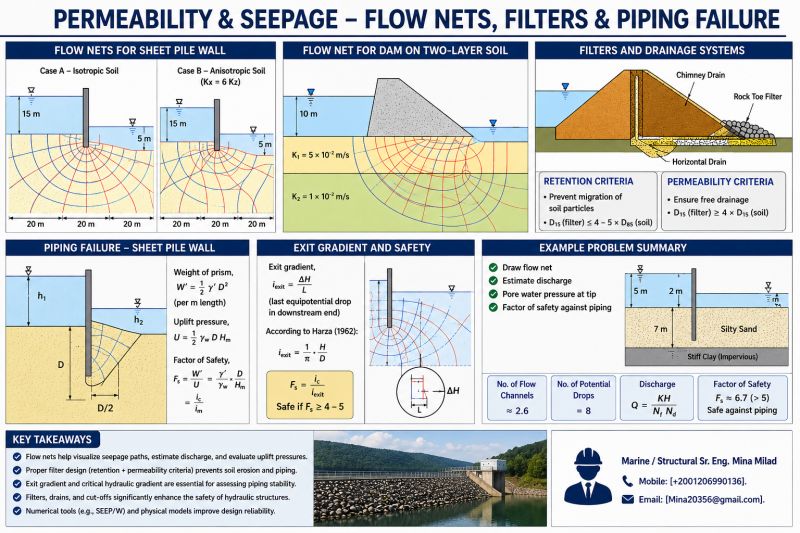
Where water stands against a fill for long enough (a blocked culvert, a pond, a river stage that lasts days), flow through the fill approaches steady state. Darcy's law governs the flow, and a flow net (or a seepage model) gives the head everywhere in the fill, the exit gradient at the toe and the quantity of seepage.
Equation 6.4-3. Darcy's law and seepage quantity
where k is hydraulic conductivity, i the hydraulic gradient, A the area, H the head difference, and Nf, Nd the numbers of flow channels and equipotential drops in the flow net.
Seepage exerts a force on the soil skeleton equal to the gradient times the unit weight of water, acting in the direction of flow. At the downstream toe the flow turns upward and outward, which is why the toe softens, sloughs and is the first place to show distress. For dam and levee-type fills the Kozeny parabola gives a quick phreatic line through a homogeneous section.