↑ Parent Menu⌂ Main Menu
← Chapter 3.3 Drilling Scope
GHRM
Railway Ground Hazard Risk Management · 3.0 · Risk Management
Sections · open a dropdown to go to a section or subsection

3.3.6 Drilling Methods and Equipment

Deciding where, how deep and how many borings and tests a site needs, and writing it so a driller can price it.
Author: Daniel P. Colwell
3.3.6 Drilling Methods and Equipment
Table 3.3-6. Drilling methods
MethodBest forLimits
Solid or continuous flight auger (CFA)Shallow borings above groundwaterSamples disturbed; holes collapse below water
Hollow-stem auger (HS)Most soil borings; SPT and tubes through the stemHeave in loose saturated sand; refusal on cobbles and cemented slag
Mud rotary (RW)Deep borings below water; loose sandsWater source needed; mud handling
Air rotary (RA)Fractured or honeycombed rock where water is lostDust; sample quality
Rock coring (NQ)Rock quality and strengthWater source unless cored with air
Dual-wall percussion, ODEX, sonicCobbles, boulders, rubble fillHigher cost; limited availability
Table 3.3-7. Rig types and access
RigUse
Truck-mountedPaved yards, roads, gravel lots, firm shoulders
Track-mounted (rubber tracks)Soft ground, slopes, brush; most railroad toe borings
ATV with balloon tiresWet fields and marsh, light footprint
Hi-railOn-track work inside a track window
Portable or tripodSteep or confined sites; hand-carried
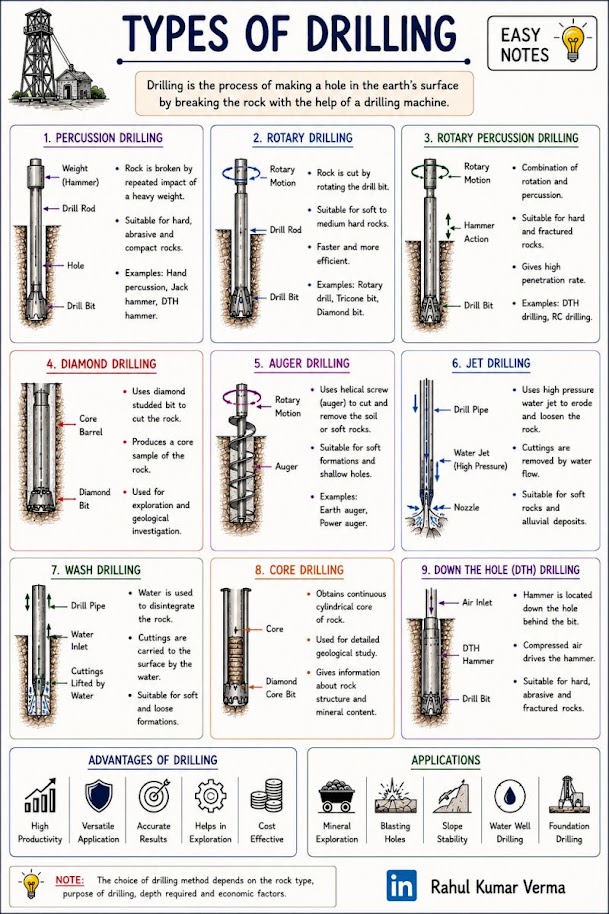
Common drilling methods. The method is chosen for the ground, the water and the access, and stated in the RFP.
Figure 3.3-5. Common drilling methods. The method is chosen for the ground, the water and the access, and stated in the RFP.
← Previous · 3.0 Risk Management Chapter 3.2 — Desktop Study
Next · 3.0 Risk Management → Chapter 3.4 — Site Review and Reconnaissance