↑ Parent Menu⌂ Main Menu
← Chapter 3.10 Mining and Man-Made Hazards
GHRM
Railway Ground Hazard Risk Management · 3.0 · Risk Management
Sections · open a dropdown to go to a section or subsection

3.10.1 Mine Subsidence Mechanisms

Abandoned mines, buried structures, utilities and old works: hazards that people put in the ground, and how to find them before they find the project.
Author: Daniel P. Colwell
3.10.1 Mine Subsidence Mechanisms
Table 3.10-1. Types of mine subsidence
TypeMining methodSurface effectTiming
Sinkhole (pit) subsidenceRoom-and-pillar at shallow depthAbrupt pit, typically 5 to 40 ft across, from roof collapse migrating up (chimneying)Decades after mining; often triggered by water
Trough (sag) subsidenceRoom-and-pillar pillar failure; longwallBroad, shallow basin; tension cracks at edges, compression at centerLongwall: during and within months of mining; pillar failure: any time
Shaft and adit collapseAnyPit at the old openingAny time; often hidden by fill
Surface mine highwall and spoilStrip and open-pitSettlement of spoil; instability of old highwallsSpoil settles for decades
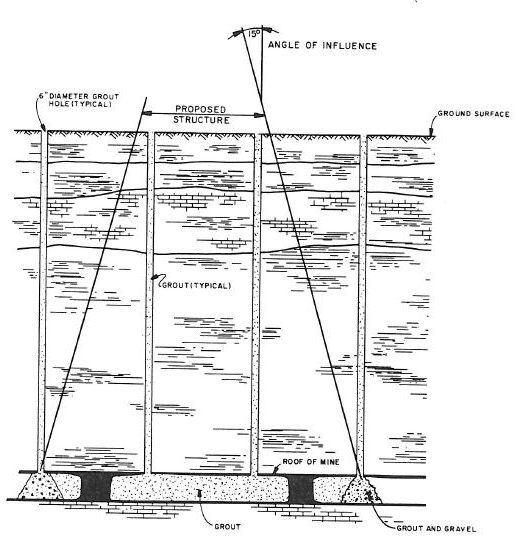
Profile view of a site remediated using Bulk Infill Grouting
Photo 3.10.1-1. Profile view of site remediated using Bulk Infill Grouting. From Ryan (1983), courtesy of GeoCon®.Source: FHWA / SHRP2 R02, GeoTechTools.org technology photo sheet.
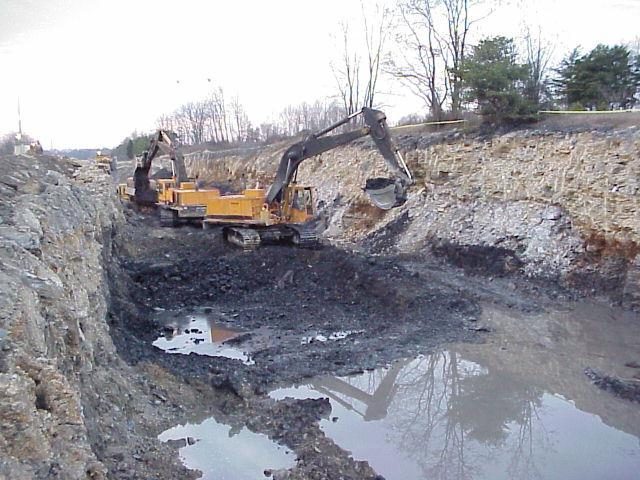
Two excavators working in a deep rock-walled excavation pit with standing water, during a mine subsidence remediation project
Photo 3.10.1-2. Excavation during an abandoned underground mine subsidence remediation, Jackson County State Route 32. From Ohio Department of Transportation.Source: FHWA / SHRP2 R02, GeoTechTools.org technology photo sheet.
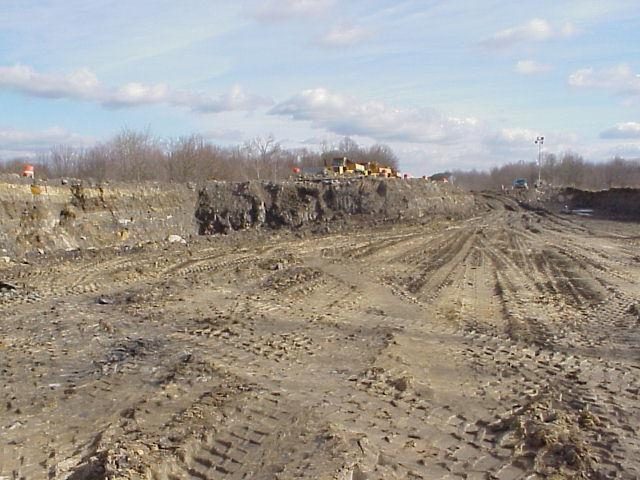
Wide excavated area with heavy equipment and tire tracks during backfilling operations at a mine subsidence remediation site
Photo 3.10.1-3. Replacement (backfilling) during an abandoned underground mine subsidence remediation, Jackson County State Route 32. From Ohio Department of Transportation.Source: FHWA / SHRP2 R02, GeoTechTools.org technology photo sheet.

Chimneying (void migration) stops when the collapsed debris, which occupies more volume than the intact rock (bulking), fills the void. A simple estimate of the maximum height of migration is:

Hmax ≈ m / (k − 1)(Eq. 3.10-1)
m = mined height (seam thickness); k = bulking factor of the caved rock, typically 1.2 to 1.5. Competent rock layers in the roof can arrest migration below this height.

A widely used screening rule is that sinkhole subsidence is possible where the cover over room-and-pillar workings is less than about 10 times the mined height, and unlikely where it exceeds about 20 times, unless the overburden is weak or water is involved. These ratios are guides for screening, not design values.

← Previous · 3.0 Risk Management Chapter 3.9 — Geotechnical Investigation Planning and Scope
Next · 4.0 Subsurface Exploration → Chapter 4.1 — Borings and Sampling